
During the development of our cables and wires, Helukabel tests each product extensively in the test laboratories. In the first part of our series we introduce you to torsion testing.
Cables and wires in industrial robots and other moving machine parts often have to withstand extreme stresses due to torsion. Constant repetitive movements place significant stress on the materials. At the same time, operators expect components to function perfectly and reliably throughout their entire lifespan to prevent malfunctions, failures and safety risks.
That is why at HELUKABEL we simulate intensive and continuous torsional stress under realistic conditions with our high-tech test equipment in Windsbach, Franconia. We have different types of equipment for this purpose, because some of our customers, for example in the automotive industry, have very precise specifications for carrying out a torsion test. The tests show that our cables and wires can withstand speeds of up to 1,000°/s, accelerations of up to 2,000°/s² and torsion angles of up to 720°. In this way we ensure that every product always meets the high demands of our customers and that they receive the impeccable quality they rightly expect from us, a leading supplier of cables, wires and accessories for more than 40 years.
WHAT IS TORSION?
Torsion occurs when a cable is twisted along its longitudinal axis. This is often the case with robot applications and in machine and installation construction, as well as in wind power stations. The resulting torsion causes deformation of the cable. The phenomenon can be compared to wringing out a wet towel. The wire is stretched in some places and crushed in others, and these applied forces are constantly changing. The torque increases linearly from the center of the cable to the surface of the sheath, where the deformation and stress are greatest. To ensure that cables and wires can withstand torsion, they require special construction with the use of suitable materials.
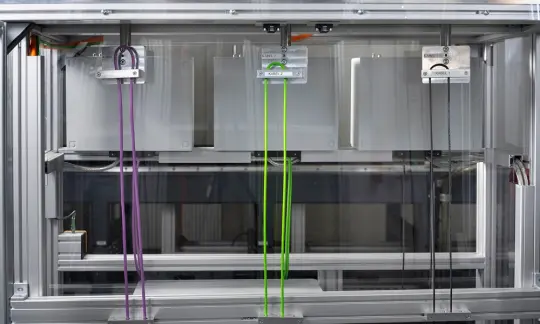
The performance of various tests also ensures compliance with customer specifications.
Mr Meyer, how do the effects of torsion manifest themselves over time?
Continuous torsion significantly accelerates the aging of cables and wires. For example, the outer jacket deteriorates more quickly, and this is more pronounced when cheap rubber sleeves are used than sleeves made of high-quality materials such as modified PVC or PUR. Various forces also act on the copper wires in the cable, which can cause them to break over time. The cable attachment points are also important: simple clamps, for example, are difficult to pass through torsional forces and are therefore subject to high shear forces. These are forces that run parallel but in opposite directions and can cause a cable to break.
Günter Meyer is head of dynamic testing at the HELUKABEL plant in Windsbach.
When shielded robot cables are needed for better electromagnetic compatibility (EMC), product developers opt for a special shield, the so-called D-screen. What is the difference between a C screen and a D screen?
A C-screen is a braid of several copper wires laid next to each other. It is the most popular type of shielding in cable construction and is used, among other things, for towing cables. The C-screen is suitable for applications with bending stress, but not for applications with torsion. It is very difficult for the braid to return to its original state after it has been rotated around its longitudinal axis. That is why we use the so-called wound screen or D-screen for torsion-resistant cables. This type of copper winding is particularly flexible because there are no wires to cross. The cable's ability to transmit torsional forces is improved and the cable can be rotated along its longitudinal axis without being damaged.
For more information about HELUKABEL, visit website, or read more news in the Newsroom.