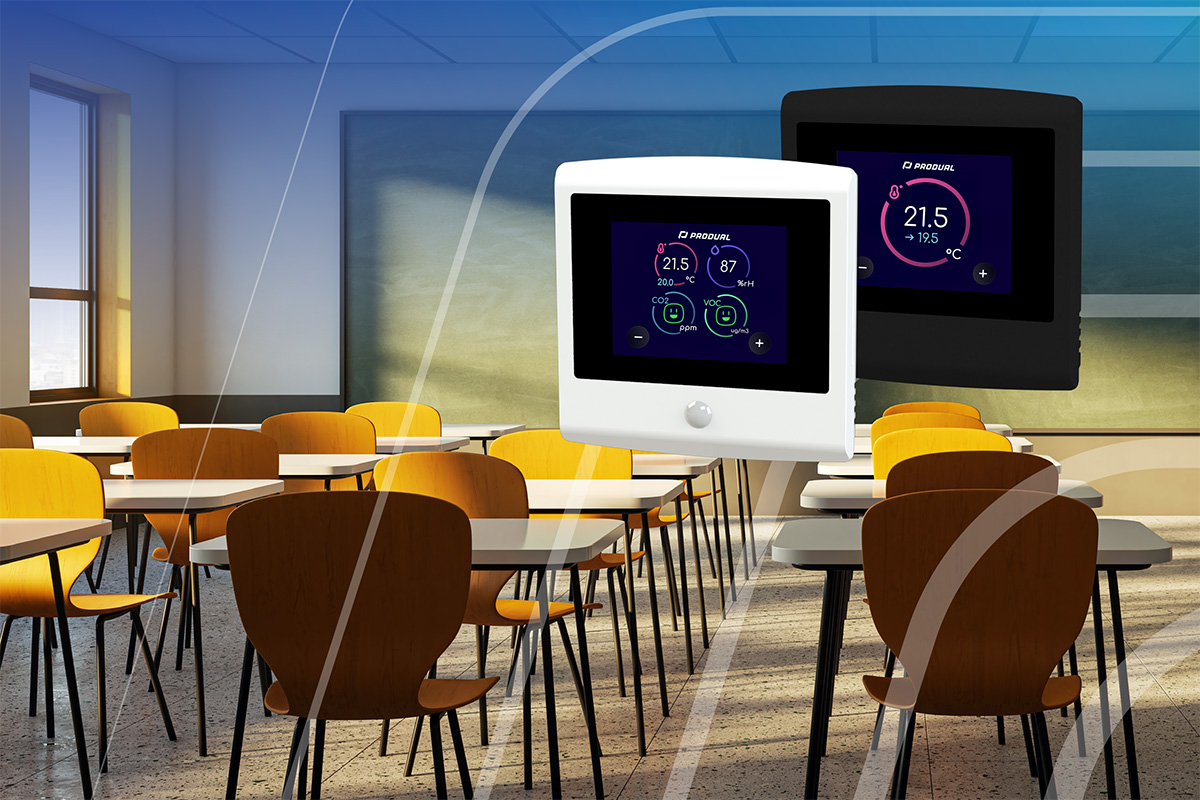
Hitma introduces new Produal RTX and RTX-D room transmitters for precise HVAC control.
Hitma is bringing two new space transmitters from manufacturer Produal to the market: the RTX and RTX D series. These transmitters have been developed for applications in building automation and HVAC, where reliable measurement data is essential for proper control. With this introduction, Hitma offers a solution to a common practical problem: installations that are technically well-designed but do not perform optimally due to inaccurate or distorted measurements.
From sensor accuracy to real-world accuracy
In many buildings, control is based on temperature and air quality measurements that are accurate under ideal conditions, but are influenced in practice by installation, airflow, or environmental factors. This can lead to unnecessary energy consumption, comfort complaints, and additional balancing work.
Many problems in HVAC systems do not arise from a lack of capacity, but because the control system relies on measured values that are not representative of the actual situation.
The Produal RTX series has been developed with a focus on accuracy in real-world situations. Through, among other things, compensation for external influences and intelligent evaluation of installation conditions, the likelihood of measurement deviations is reduced.
Two versions for different applications
The new series consists of two variants:
- RTX series
A room transmitter with PI control, suitable for standard HVAC applications where reliable temperature measurement and stable control are central. - RTX-D series
A multifunctional version with a display and extensive measurement capabilities. Depending on the configuration, in addition to temperature, CO₂, relative humidity, and VOCs can also be measured. This makes this variant suitable for applications where indoor air quality and demand-controlled ventilation play an important role.
More control over comfort and energy consumption
Reliable measurement data forms the basis for a well-functioning control system. More accurate measurement makes it possible to:
- to better align ventilation with actual needs
- to limit overventilation and energy loss
- to reduce comfort complaints
- to perform commissioning more efficiently and consistently
Particularly in buildings with many rooms or in renovation projects, where installation conditions vary, this can make a noticeable difference.