Sustainable building management and energy storage technology becomes visible in Johan Cruijff ArenA
The Johan Cruijff ArenA, together with the surrounding area, forms a testing ground for technological innovations. During an end-user agreement between the Building Automation sector and MinacNed, various applied technologies were discussed in a number of presentations.
By: Dimitri Reijerman
Huib Pasman, tech strategist for the ArenA, kicked off. He stated that the grass is the most important asset in the Johan Cruijff Arena: “it is the basis for our income”. After a number of innovation steps, the JC ArenA has now focused on further sustainability. It does this with numerous partners. According to Pasman, the stadium is now a 'data-driven' platform. In this way, the turf is closely monitored with sensors, but sufficient human customization remains: “We don't do this without a biologist,” says Pasman.
Microsoft, partner of the Johan Cruijff ArenA, also contributes to the innovations in and around the stadium. Chris Nouveau, digital advisor at Microsoft, spoke about how the IT giant is responding to the needs of smart spaces: “We need to become greener, but we also need to reduce costs,” he said. He also delved deeper into the Internet of Things, where within that architecture the things-insights-actions link already served as a guideline.
Nanocoatings
The startup Delft IMP is trying to improve the lifespan of lithium-ion batteries with nano coatings, among other things. According to Sebastien Moitzheim of Delft IMP, the demand for batteries will continue to grow due to sustainability, while the security of supply of Cobalt is unclear in the future. By improving powders with nanocoatings, the startup hopes to make safer and more stable batteries that also last longer. The technology already works well on a lab scale, but Delft IMP hopes to quickly scale up to industrial production.
Martijn Fransen from Malvern Panalytical answered the question: what actually happens in a lithium-ion battery. He explained how X-ray diffraction can be used to look inside a battery without destroying it. This is important for research into safer batteries.
Vehicle-2 grid
Jan Winkler from The Mobility House spoke about another ambition of the JC ArenA: installing thousands of charging points in the parking garages under the stadium. This becomes necessary due to the sustainable ambitions of the municipality of Amsterdam. He also explained how the energy storage system has not only replaced diesel generators for emergency power, but the system also makes money. For example, the used batteries from Nissan vehicles are used for grid services and peak shaving.
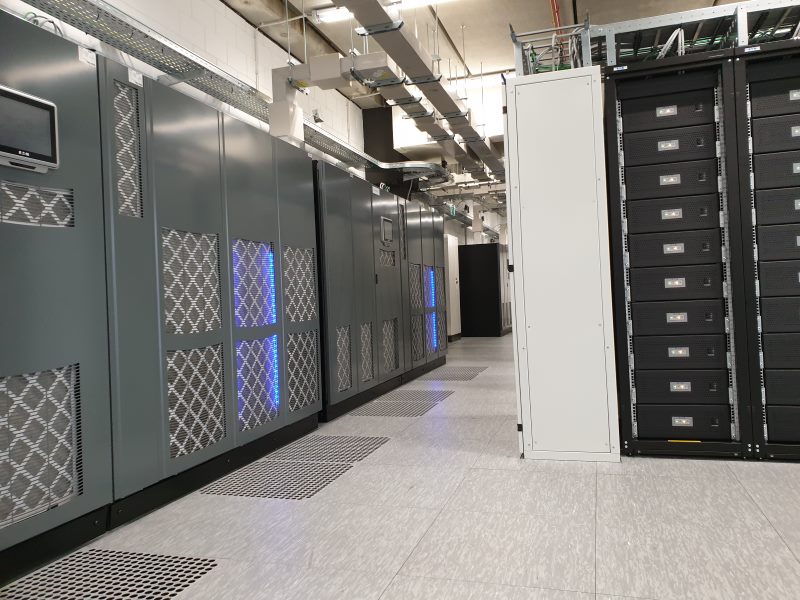 Vehicle-2-grid applications are also being looked at. The company is now installing unidirectional chargers for smart charging on a small scale. The participants in this project want to learn how this concept works in practice. It also saves a lot of money because heavy cabling and transformers are not required.
The closing event was Jan van Dijk from Honeywell. He indicated how cost savings are possible by applying a new building management system. The management and maintenance of the building is optimized using IoT sensors that monitor installations at more than 2,000 points in the stadium.
The end user agreement was concluded with a tour of the Johan Cruijff Arena. The energy storage system was also shown. If Amsterdam is hit by a prolonged power outage, the mega battery can supply the stadium with power for approximately 3 hours.
Related companies


 Nederlands