
A CERTAIN IMAGE COMES TO MIND WHEN PEOPLE TALK ABOUT ROBOTS. BUT WHAT IS A ROBOT AND WHAT ISN’T IT?
Prof. Christian Wurll: One definition specifies when a "contiguous series of mechanical movements" becomes a robot. According to that definition, at least three axes must be mechanically connected. But there are many machines with only two axes - for example in the packaging industry - and these are also called robots.
Ronald Benedek: But isn't a machine tool also a robot? They usually have more than three moving axes.
Dr.-Ing. Werner Kraus: The difference is that a robot can be used for various applications, while a machine tool is built for a specific purpose, for example milling. What a robot is and what it is not is therefore open to interpretation. For example, many manufacturers of driverless transport systems do not consider themselves to be robot manufacturers but rather logistics service providers. The question of autonomy also plays an important role in the definition.
Below deck: The typical image that comes to mind when we talk about robots is the industrial robot in the factory – a mechanical arm that moves and rotates.
WHAT ROLE DO CABLES AND WIRES PLAY IN ROBOTICS AND WHAT REQUIREMENTS MUST THEY MEET?
Holger Dietz: Six-axis robots are extreme environments for cables: they must withstand bending, torsion, tensile stress and other conditions. Robots also operate in extreme temperatures and come into contact with dust, dirt, moisture and chemicals. This is truly a very challenging environment.
Janik Ebner: Cables and connectors are critical components in robotics, and they are at risk of failure after millions of cycles of movement. It goes without saying that our robots are designed so that the cables never kink. But torsion in particular is unavoidable in many applications.
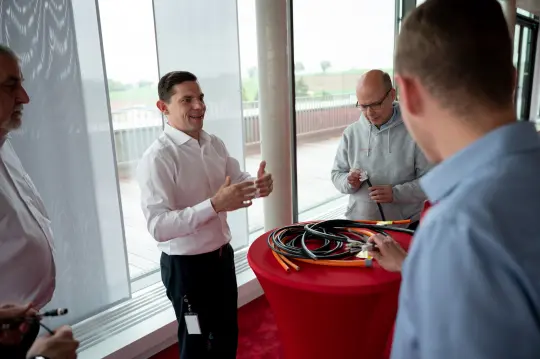 The discussion between the experts also addressed current and future areas of application.
Below deck: It is this aspect in particular that makes robotics so fascinating for us as a cable manufacturer. In order to enable movement along the longitudinal axis, our robot cables are constructed very differently from other cables. This starts with bundling and continues beyond the insulation of the conductors and the twisting to special foils and membranes that are applied to the cable to make it torsion-resistant.
Vincenzo Rio: When it comes to robots used for welding, the issue of welding spark resistance must also be taken into account. We have been getting more and more questions about this lately, also from the automotive industry.
DYNAMIC LOADING IS THEREFORE THE BIGGEST CHALLENGE FOR COMPONENTS IN ROBOTICS. HOW CAN RELIABLE PERFORMANCE BE GUARANTEED AND HOW CAN POTENTIAL FAILURES BE DETECTED EARLY?
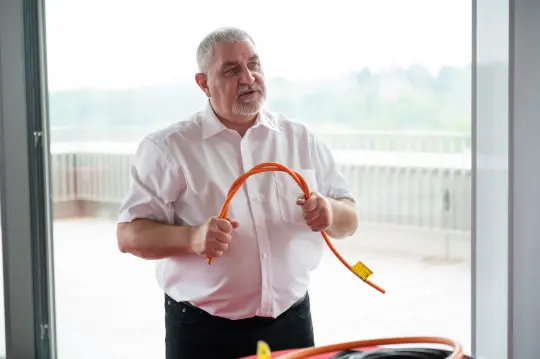 Robot cables must withstand high mechanical stresses – torsion in particular is a challenge. That is why our robot cables are constructed very differently from other cables.
Horst Messerer: Of course, we spend a lot of time on the lifespan of our cables – but the cable is only one part of the robot. There are also electronic components that can break, or bearings and motors that can wear out. Even data cables get old over time and become more susceptible to failures. In applications with real-time data transfer, packet or bit errors will eventually affect the performance of the entire system. For example, they can affect the timing of a machine. But where the limits lie depends very much on each individual case. That is why 'condition monitoring' of data cables is also a concern of ours.
Ebner: For predictive maintenance, various data, such as the distance travelled by the motors, are collected and transmitted from the robot. Based on empirical data, for example, it can be predicted very accurately when an axis needs to be maintained or a tool needs to be replaced.
Dietz: Robots in the automotive sector – for example on welding lines – have a lifespan of up to 16 years. The right cables can easily handle that. In addition, the topic of retrofitting robots is currently on the rise. Since the delivery times of new models are sometimes very long, there is a lot to be said for retrofitting and repairing old robots. It can also be a good idea to replace the cables at the same time.
Wurll: When a robot stops working properly, it is probably due to a broken peripheral component such as a gripper or the welding technique. The repair of these is the responsibility of the system integrator who equipped the robot with the components. Peripherals make up the largest part of the costs of most robotic systems. This is where the focus should be when planning predictive maintenance.
THE SPATIAL SEPARATION BETWEEN HUMANS AND ROBOTS IS DECREASING IN MANY JOBS – KEYWORD COBOTS. WHAT CHALLENGES DO YOU THINK COME WITH THIS?
Kraus: One of the most important points is to prevent accidents as much as possible. After all, the risk of being injured by a cobot without a safety fence around it is considerably greater than by an industrial robot in a completely enclosed space. People who work with robots must receive appropriate training, for example by taking a kind of “robot driving test”. It is often overlooked that robots can also perform unexpected movements at any time – this can quickly lead to collisions. That is why the driving speed of cobots is considerably lower.
Dietz: There have been attempts to monitor the behavior of cobots using cameras to evaluate and prevent collisions in the future. Depending on the application, data protection rights must be observed here, as employees may feel that they are being watched by such systems.
Ebner: It is also worth noting that, although it is possible to collaborate without spatial separation between human and robot, there are many operators who do not want this. As a result, in practice, cobots are often not used as cobots, i.e. as collaborative robots, in the true sense of the word, but as compact variants of the more traditional industrial robot.
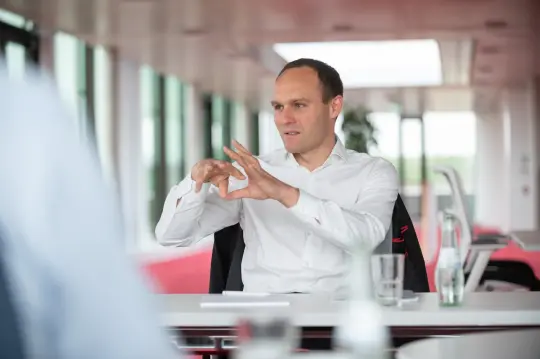 “Due to demographic changes, the demand for robots is also growing outside of industry.” Dr.-Ing. Werner Kraus, Fraunhofer Institute for Production Engineering and Automation IPA
COBOTS AND A NEW GENERATION OF EASY-TO-OPERATE INDUSTRIAL ROBOTS ARE MAKING THE TRANSITION TO ROBOTICS EASIER FOR MANY OPERATORS. BUT WHEN IS THE RIGHT TIME TO INVEST IN ROBOTICS AND WHAT BENEFITS CAN BE EXPECTED?
Ebner: This depends very much on the application in question. In general, cobots and a new generation of compact and easy-to-operate industrial robots, such as our HORST, are aimed at small and medium-sized companies, where only a small percentage of robots are in use so far. It is not about high-end applications, but rather about gaining initial experience with the technology and discovering how one can enter this field in a simple and economically viable way. It often starts with the idea of purchasing a robot, and the concrete application only crystallizes later – it is de facto the opposite of how it is with the traditional robots that we know in the automotive industry, for example. Cobots and the new generation of industrial robots are also much more flexible and are not designed to repeat the same task for six or ten years. They offer a completely different level of accessibility, both in terms of price and in terms of setup and operation. That is why we are convinced that there is still great potential here.
AS DIGITALISATION REGULARLY ASKED THE QUESTION OF WHETHER AUTOMATION AND ROBOTICS WILL DESTROY JOBS OR CREATE NEW JOBS. IN WHICH KEY TECHNOLOGIES WILL HUMAN JOBS BE TAKEN OVER BY ROBOTS? WHERE DO YOU SEE OPPORTUNITIES AND POSSIBILITIES FOR NEW JOBS THROUGH ROBOTICS AND AUTOMATION?
Dietz: I do not see robotics as a threat to human jobs, but rather as an improvement. Here in Germany, there is a shortage of skilled workers; it is becoming increasingly difficult to find qualified personnel for many jobs. Robots can take over physically demanding or monotonous work that people do not like to do – and do it 24/7, without breaks and with a high degree of precision. I think it is unlikely that jobs in these sectors will disappear, because even now we do not have enough skilled workers. It may be different in low-wage countries where more workers are available. On the other hand, new jobs are being created for people who program and operate robots. However, providing adequate training for staff to do these jobs is certainly a major problem for companies. This is something we will have to address in the coming years.
 “Robotics is not a threat to human jobs, but rather an improvement.” Holger Dietz, Business Unit Manager, Robotec-Systems GmbH
IN MEDICINE AND HEALTHCARE, IN GASTRONOMY, IN PRIVATE HOUSEHOLDS OR FOR CHILDREN'S TOYS: THE POSSIBILITIES OF APPLICATION OF ROBOTS SEEM ALMOST LIMITLESS, EVEN OUTSIDE INDUSTRY. WILL WE BE SURROUNDED BY ROBOTS IN 10, 20 OR 50 YEARS FROM NOW IN ALL AREAS OF LIFE?
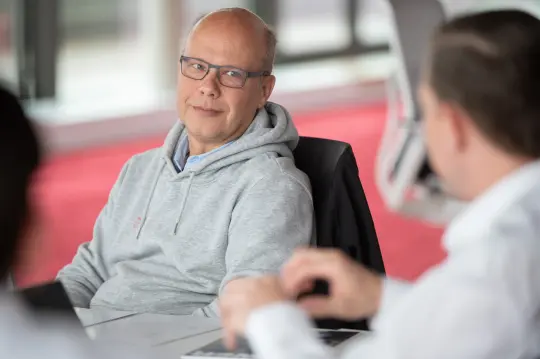 What is the state of research in robotics? Prof. Christian Wurll (l.) and Dr.-Ing. Werner Kraus provided fascinating insights.
Below deck: I see a trend towards service robots. Robots will increasingly be used in households, nursing homes and hospitals. For example, they will help people lift heavy objects or do other things that they can no longer do for health reasons. There are already robots that autonomously enter hospital rooms and disinfect them using UV light. I suspect that there will be some sensible or nonsensical idea for robots that are aimed at helping individuals instead of industry.
Dietz: I also see great potential in the medical sector. Assistive robots are already being developed to perform endoscopic operations, for example. In such operations, up to four doctors usually stand close together around the patient. The robot, on the other hand, has up to four arms and is controlled via a console, monitor and camera – this allows for a much better overview. Physiotherapy treatments or adjustable operating tables are other important emerging areas of application. In addition, the use of robots is of course preferable when it comes to working in areas that pose a risk to health or life, such as bomb explosions or nuclear reactors.
Wurll: We are currently spending a lot of time on construction sites, where we are developing a robot together with a construction company to build limestone walls. Robotics is also an interesting area for agriculture. We are in contact with a number of gripper manufacturers who are thinking about automatic strawberry or apple pickers. Outdoor suitability naturally plays an important role here. The technology must work in all weather conditions. Companies such as Google are investing huge sums in so-called Everyday Robots. These are mobile platforms with arms that can, for example, straighten chairs and clean tables in restaurants and cafés. Whether they will really take off in the sector is difficult to say at the moment, but they are certainly a new trending topic in gastronomy.
Kraus: I think that the progress that robotics is making in manual activities is significantly greater than in language-based interactions. There is an interesting parallel here with the evolution of human language skills, which evolved significantly later than our manual dexterity. Likewise, I think it will be difficult for us to model and control this in the form of artificial intelligence. That is why I think the next robotic revolution will be mobile platforms for logistics, for example.
Wurll: There are already innovative approaches to loading trucks and swap bodies. A US supplier recently demonstrated a mobile platform with a custom-designed arm optimized for a swap body. The robot can move into the body and use a telescopic conveyor to locate and load boxes. It doesn’t necessarily do this faster than a human, but it doesn’t need to take breaks. This means there are already potential productivity gains.
Kraus: Another application that is currently growing rapidly is the welding robot. The shortage of skilled welders is particularly acute, and it doesn’t matter if the robot moves slowly – welding has always been a time-consuming task. One of the topics we are currently working on at the IPA is therefore the intelligent recognition of the start and end of a weld and automatic adjustment based on welding tolerances. We believe there is a lot of potential for robotics in welding.
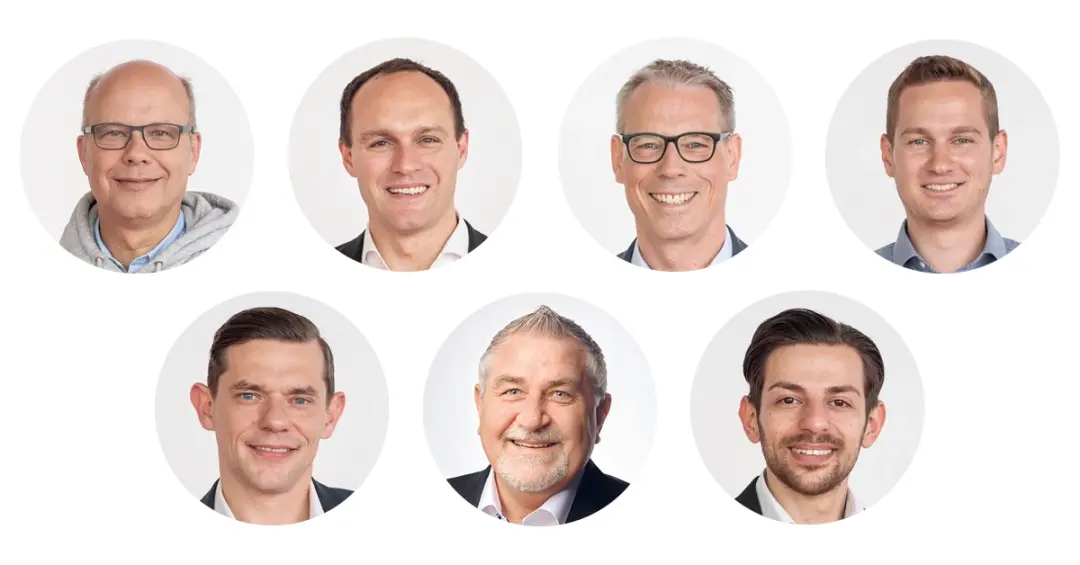
ABOUT THE PEOPLE
- Prof. Dr.-Ing. Christian Wull is a professor of electrical engineering and automation at the Faculty of Management Sciences and Engineering of Karlsruhe University of Applied Sciences. His field of expertise is robotics and automation technology. He is also the spokesperson for the Institute for Applied Research. Before that, he worked for 16 years at the robot manufacturer Kuka.
- Dr.-Ing. Werner Kraus is head of Robot and Assistance Systems at the Fraunhofer Institute for Production Engineering and Automation IPA in Stuttgart. Among other things, the institute is building a “Robotics Valley” in Baden Württemberg with the aim of bringing together different players in the field of robotics.
- Janik Ebner is project manager at fruitcore robotics GmbH. In 2018, the Konstanz-based company launched the HORST industrial robot, which has enabled small and medium-sized companies in particular to make a simple and affordable entry into robotics.
- Holger Dietz is Business Unit Manager at Robotec Systems GmbH, a subsidiary of HELUKABEL. The company from Duisburg specializes in hose packages and clothing packages for media technology in industrial robotics. Dietz has worked in the past for various machine and installation companies, including Kawasaki Robotics.
- Ronald Benedek has been working at HELUKABEL since 2008 and, as Team Leader Automation & Drives, deals with topics in the field of drive technology and robotics. Vincenzo Rio has been strengthening the team around Ronald Benedek as an Expert for Robot Cables since 2020. His tasks include managing industry-specific product portfolios and supporting HELUKABEL's international subsidiaries.
- Horst Messerer is Product Manager Data, Network and Bus Technology at HELUKABEL. Before joining the company in 2014, he worked in the cable industry for 28 years. He is also active in various bus and Ethernet associations and is very well informed about current standards.
You will also find these and many other interesting articles in the current issue #12 of our customer magazine POWER. Read this now!