"Enormous possibilities, of which in many cases we are not yet aware"

Megatrend industrial automation: experts discuss opportunities and challenges
Whether it concerns production, assembly, internal transport or logistics: Automation is being integrated into more and more processes in all sectors and business sectors and is changing them from the bottom up. Cables and wires are like a nervous system: When necessary, they send signals, data and power from the sensor through the controller to the management level. In a discussion with experts, we took a closer look at the challenges facing industrial automation, as well as likely future developments and trends in this exciting field.
THE TERM “INDUSTRIAL AUTOMATION” IS VERY BROAD AND INCLUDES MANY SUBDISCIPLINES. WHAT IS YOUR DEFINITION OF INDUSTRIAL AUTOMATION?
Martin Schleef: Imagine a machine or a set of connected machines that repeatedly perform specific tasks at high speed. Simply put, industrial automation is about how you control these machines, that is, how you start them, stop them in the middle of production or make improvements. The most relevant benchmark here is the so-called overall equipment effectiveness or OEE. This metric shows equipment utilization versus production time and converts availability, performance and quality levels into easy-to-visualize ratios. At Fraunhofer IPA we investigate how OEE can be improved using sensor technology, artificial intelligence and other technologies.
Matthias Eick: As I see it, the goal of industrial automation is to automate processes with high repeatability and eliminate the need for human involvement. Such processes are no longer the exclusive domain of the shop floor: there are many other areas that are also benefiting from advances in automation. There are now a plethora of smaller, more powerful and easier to use tech tools on the market.
Steffen Quadt: The term is no longer exclusive to the manufacturing sector. Agriculture is also a kind of industry. In my opinion, the primary goal of industrial automation is to improve productivity. This can be done through technology, but also through new methods and approaches. The same technology can produce completely different results depending on how it is deployed.
Frank Sangel: In addition to productivity, automation is also about relieving people of monotonous and tiring tasks, which benefits process safety.
Schleef: That's right. We distinguish between various driving forces behind automation, such as quality in the form of repeatability, for example, or ergonomics and staff availability.
Eick: Automation not only means making processes more productive, but also optimizing the use of resources. For example, machines in the processing industry can plan and use material much more efficiently using calculation models.
THE AUTOMATION OF INDUSTRIAL PROCESSES IS AN INTERACTION OF DIFFERENT COMPONENTS. WHAT DO YOU ACCEPT IS AUTOMATION TECHNOLOGY?
Quadt: We view automation technology from both a vertical and a horizontal perspective. The vertical perspective is the famous automation pyramid divided into several levels: At the very bottom at the so-called component level are the actuators and sensors; above this are the control level, production management technology and business planning management level. The goal is to always automate from bottom to top in a structured manner. This approach provides a schematic picture of the automation. There is also a horizontal perspective, the so-called product life cycle. This starts with the definition of requirements in the development phase, long before production starts. In addition, it continues until there is a successor or the product is discontinued and includes the supply of spare parts. The horizontal perspective is becoming increasingly relevant in light of issues such as sustainability, energy and resource efficiency.
Eick: For most users, it's almost impossible to see things in this all-encompassing way. In practice it is more a matter of “I want to make a certain product, so I have to adapt my processes accordingly”.
Quadt: And that is precisely why the evolution of automation technology is far from over. Artificial intelligence and predictive algorithms will be used much more in the future to analyze and optimize activities. The two-dimensional view we have now will likely expand to multiple dimensions.
INDUSTRY 4.0, IIOT AND BIG DATA: INDUSTRIAL AUTOMATION IS SLOWLY BUT STRONGLY MOVING TO IT. WHAT OPPORTUNITIES AND RISKS DO YOU SEE THIS ARISING?
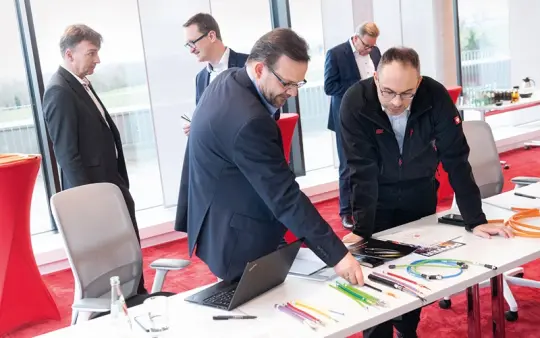 Cables and wires are like a nervous system for industrial automation: They transmit signals, data and power when necessary.
Schleef: Right now we're collecting a lot of data, but we're not doing anything with it, and that's a problem. The question is: who owns the production data? From the production company or from the machine manufacturer? Sharing data also means giving up sensitive information, which many companies are reluctant to do.
Jurgen Berger: And IT in small and medium-sized businesses is usually not as good as it should be. The implementation of new technologies also opens the door to external attacks, so companies must also protect themselves against this. Many worry about this vulnerability when introducing automation, as cyber attacks can, for example, shut down production. However, it is less about individual processes than about a fundamental willingness to accept this risk.
Eick: IT security is the fastest changing area in industrial automation. Companies cannot treat this as a one-time issue. Instead, they need to keep their eyes on the ball and they need outside help to do this.
Quadt: That's true. Cybersecurity requires many highly qualified and skilled people. But once it's in place, automation opens up enormous possibilities, many of which we are not yet aware of. There are connections that we do not yet see because they are so complex. Advanced algorithms and machine learning allow us to better understand complexity and recognize patterns that were previously unknown.
FOR A LONG TIME, AUTOMATION WAS ONLY FOR LARGE COMPANIES. HOW CAN IT ALSO BE MADE ACCESSIBLE FOR SMALL AND MEDIUM-SIZED COMPANIES?
Schleef: The level of automation is usually higher in large companies than in small and medium-sized companies. But if you don't invest in automation, it will eventually become a problem, for example when productivity drops and a company loses its competitive advantage. I see enormous potential for robotics here, especially for cobots: The application possibilities are literally exploding and robots are becoming cheaper and easier to use. Most people don't realize how easy it is to program a cobot. And through “imitation learning” robots also teach themselves a lot.
Quadt: The first hurdle for many companies is the high costs. These are unavoidable, but they quickly pay for themselves because operators want to make maximum use of their machines. The best machine is not necessarily one that is optimized to perform a single task quickly and efficiently. A machine that is flexible enough to perform multiple tasks may be more suitable.
Schleef: That's absolutely true. Even large manufacturers, for example in the automotive industry, are increasingly investing in innovative concepts instead of highly specialized assembly lines. One of these concepts is so-called matrix production, in which products follow flexible paths between production cells, so that various variants can be better mapped. This approach is also interesting for small and medium-sized companies that produce smaller quantities.
Eick: The flexibility of Industry 4.0 – where batch sizes as small as 1 are economically feasible – inevitably comes at the cost of slightly lower efficiency. Small and medium-sized businesses don't have to redesign the entire workplace at once. Instead, they can start with an island solution with decentralized drive technology or replace individual systems and components. This way they can gradually become familiar with automation.
Schleef: Many companies have no idea how to optimize their machinery beyond the existing level of automation - be it through further digitalization, extensive registration of measurement and quality data or artificial intelligence. But if they do, it will open many new doors, even for systems that were already thought to be performing optimally. There are public support programs, such as the so-called Quick Checks, that companies can use to have their factories analyzed and assessed in a few days.
Sangel: The time and cost of connecting and wiring automation technology used to be enormous, which deterred many machine builders. However, nowadays everything is pre-configured and assembled, which makes things much easier.
INDUSTRIAL AUTOMATION IS ALWAYS ASSOCIATED WITH JOB LOSS. IS THAT TRUE?
Schleef: Some people like to argue that the purpose of automation is to reduce costs by cutting staff. But this argument is not convincing: There are many professions where companies find it difficult to hire anyone at all and this almost forces them to go down the automation path. Automation is not a threat, but a guarantee for jobs. Because many activities would no longer be possible if automation did not compensate for the lack of personnel.
Quadt: Automated industries also need qualified professionals, sometimes more than before. The job description is just different. The craft industry is in a similar situation. In my opinion, politicians here need to do more to address this shortage.
Berger: That's exactly what I think. For example, here in Germany we are dependent on immigration, so we should make more efforts to integrate foreign skilled workers. We have a lot of catching up to do.
Eick: But the skills shortage is not unique to Germany. We are also finding it increasingly difficult to recruit suitable people for different jobs in other countries, for example in Eastern Europe.
Quadt: Automation has another important advantage: it makes redundant the tiring, monotonous or dangerous work that no one wants or is allowed to do anymore. We need to make use of people's other strengths, for example their flexibility. As a society, it is our responsibility to encourage qualifications and professional development rather than perpetuating outdated jobs and activities. We do not depend on raw materials for our prosperity in Central Europe, but on technologies and our ability to develop and exploit them.
IN THE FUTURE, COMPANIES WILL NEED TO MAKE THEIR PRODUCTION AND LOGISTICS BOTH SMARTER AND GREENER, IE MORE SUSTAINABLE. HOW CAN AUTOMATION HELP WITH THIS?
Sangel: For example, there are injection molding machine manufacturers who now use servo motors instead of hydraulic power to hold their tools. The big advantage of this is that the servo motor only needs energy when it is moving, while a hydraulic system needs power all the time. Large manufacturers often use dozens of these machines. The energy saving potential is enormous. There are studies showing that replacing pneumatic and hydraulic systems with electrical automation technology reduces energy consumption by ten percent. The production of compressed air is very energy intensive and on top of that there are all the leaks. In addition, small servo drives are considerably easier to automate than compressed air cylinders.
Eick: When it comes to cables, hybrid cables are a smart way to save resources. Power and data are combined in one cable. This means I only need one cable instead of two, saving on production materials. In addition, there are many other components such as drag chains and couplings that can be dimensioned smaller and more efficiently. In this way, we contribute to a greener environment with our products.
Quadt: Machines and components with a long lifespan also contribute to sustainability. A gearbox, for example, can be used for decades. Electronic equipment, on the other hand, becomes outdated more quickly. So the goal should be to develop strategies to improve longevity, for example by updating or upgrading devices rather than replacing them.
Sangel: And this brings us to the topic of retrofits, which is also a step towards better sustainability. In machine tool construction, for example, it is worthwhile to modernize old machines, because the mechanical parts still have a long service life. When automation technology is replaced, the result is often a much more efficient machine at a fraction of the cost of a new one.
Quadt: In the future, we must develop automation technology that supports a circular economy. Raw materials such as magnets and rare earth metals are expensive. Some are very difficult to find and others can only be found in crisis areas. That is why it is becoming increasingly important to think about processes such as the dismantling and recycling of these materials during the design phase of a new product.
MANY SECTORS IN THE INDUSTRY ARE NOW FULLY AUTOMATED. WHERE DO YOU STILL SEE OPPORTUNITIES AND WHAT NEW APPLICATIONS DO YOU HAVE IN MIND FOR THE FUTURE?
Berger: Predictive maintenance, i.e. the maintenance of machines and equipment through condition monitoring and data analyses, is a big topic. In theory this is already possible today, but in practice it does not happen, and often for simple reasons: for example because the relevant measurement data are not defined. Sometimes there are problems preparing the data. Or there are problems with defining the evaluation criteria, something that is very complex and must be done for each individual application.
Quadt: There are so many accidents involving machines and equipment, some of which we don't even know about. The only way to make progress here is to create a measurement culture and record as many measurable parameters as possible. Smart algorithms can later figure out which of these are relevant. It must be clearly explained to the customer: we have an idea, but not the solution! We must work together to find it. Many companies are aware of condition monitoring and predictive maintenance, but an important part is often still missing.
Schleef: The many possibilities for automation in the assembly workshop should not be forgotten. Here, many tasks that cobots could perform are still done manually. Craft activities, such as construction, are also being automated on a large scale. Another trend is digital tools such as data glasses and HoloLens glasses that, among other things, support remote employees during commissioning or maintenance by providing them with information and instructions.
Quadt: In any case, man and machine are coming closer together and are better connected. Maintenance in a semi-virtual environment is an example of this. Many activities can be carried out faster, more effectively and with fewer errors. For example, virtual designs of machines and equipment already exist, but in the future it will be possible to commission them virtually. Optimization opportunities are discovered before equipment is physically built. I am convinced that the development of industrial automation is still in its infancy.
ABOUT THE PEOPLE
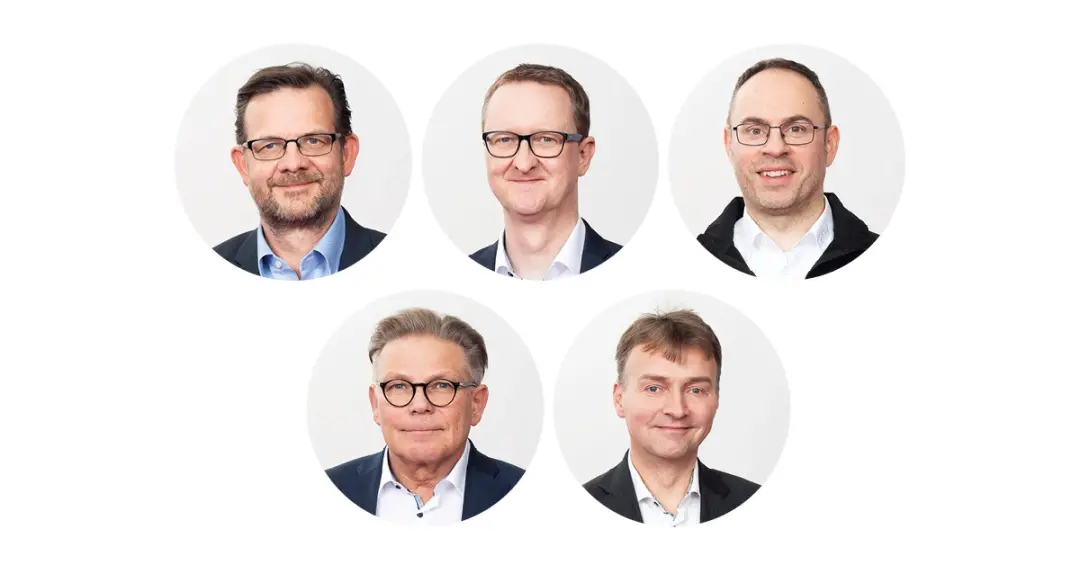 from left to right
Jurgen Berger is a born and bred HELUKABEL employee and has been with the company for 25 years. He is responsible for data, network and bus technology products.
Matthias Eick has been global segment manager at HELUKABEL since 2014 and is responsible for automation and drive technology. He was born in Lower Saxony, Germany, and has been active in the cable sector for 17 years.
Steffen Quadt is product manager at SEW-EURODRIVE GmbH & Co KG in Bruchsal, Germany. After completing his double degree in mechatronics, he worked for 16 years as a drive technology engineer in the R&D of sensor technology and digital motor integration.
Frank Sangel is the founder and director of Sangel Systemtechnik GmbH, which became part of the HELUKABEL Group in 2022. The company is based in Bielefeld, Germany, and is a leading manufacturer of cable assemblies and system modules for machine and installation technology.
Martin Schleef is business division manager machine and installation technology at the Fraunhofer Institute for Manufacturing Engineering and Automation IPA in Stuttgart. The graduated process engineer worked for various international companies, including companies in the electronics sector, before dedicating himself entirely to applied research.
You will also find these and many other interesting articles in the current issue #13 of our customer magazine POWER. Read it here!