
HELUKABEL works with Callan Marine to power their floating dredging equipment
The shipping industry is only as good as the canals and waterways that allow cargo ships to pass through, and the ports where ships can load and unload valuable cargo. This was never more apparent than when the Suez Canal was blocked in early 2021, costing the world billions of dollars in trade per day while this vital passage was blocked.
Navigating deep oceans is much easier than traversing narrow waterways or shallow harbors that can change at any moment as the water carries silt and other debris with the current. To ensure that seabeds and banks remain at the correct depths and widths, dredging companies use fleets of ships to dredge seabeds and deepen waterways to ease navigation and prevent ships from running aground and becoming stuck. Additionally, removing sediment from the seabed replenishes beaches by creating new habitats and recreational spaces. The added coastlines also improve protection against storms, such as hurricanes.
POWERFUL ENGINE POWER OF 24,000 HP
One of these companies, Callan Marine, based in Galveston, Texas, along the Gulf Coast of the United States, recently designed and built a 290-foot (90-meter) long cutter suction dredger called the General MacArthur. The MacArthur is powered by three diesel engines that together generate a power of 24,000 hp. These engines provide the necessary electrical energy to drive two electric motors of 6,900 hp each, which in turn drive the pumps on the main deck and two electric motors of 2,500 hp each, one for the submersible pump and one for the cutting head. The opportunity to support Callan Marine arose when the engineer who designed the dredger sought advice from the Italian electric motor manufacturer on the best choice of cables for the project. The engine manufacturer suggested HELUKABEL because they had already worked together on many successful projects in Europe.
HELUKABEL initially started developing the design of the cabling system for the power section of the submersible pump and the cutting head motor. “One of the biggest challenges in building the General MacArthur was finding the right submersible cable for the high power requirements of these engines,” explains Stanley Hamidjaja, Automation Manager at Callan Marine. The cables run through a structural arm (the ladder) that submerges both engines. It was not possible to achieve the required capacity with only one cable for each phase.
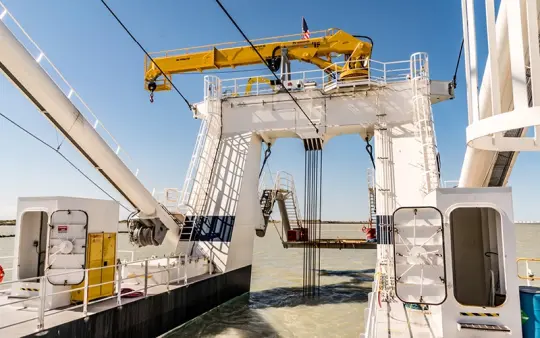 After the General MacArthur emerged from the dock, it was sent to the Gulf Coast. (© Callan Marine, LTD.)
HELUKABEL initially started developing the design of the cabling system for the power section of the submersible pump and the cutting head motor. “One of the biggest challenges in building the General MacArthur was finding the right submersible cable for the high power requirements of these engines,” describes Stanley Hamidjaja, Automation Manager at Callan Marine. The cables run through a structural arm (the ladder) that submerges both engines. It was not possible to achieve the required capacity with only one cable for each phase.
“The HELUKABEL team was deeply involved in submitting and resubmitting their proposal for over a year until they delivered the cable specification and quality that met our requirements,” Hamidjaja recalls. Working with Callan Marine's engineering team, HELUKABEL was able to supply eight AWG4/0 cables per phase, totaling 32 cables to supply the required power. These cables had submersible ratings up to 10 bar pressure and the required American Bureau of Shipping (ABS) approval required for the use of cables on ships and offshore structures.
CUSTOM SEALING INSERTS FOR CABLE GLANDS.
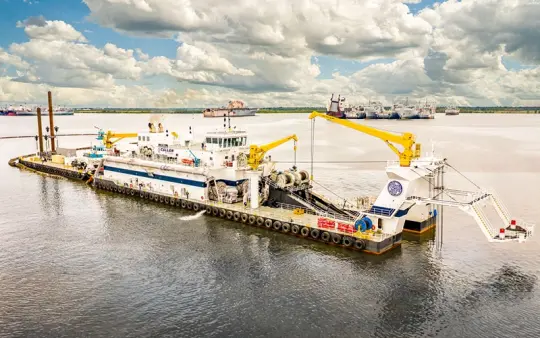 (© Callan Marine, LTD.)
The next challenge was to help design the necessary waterproof transition box for the system, which would also terminate the braided shields of the VFD cables. We achieved this by designing the transition box with our KVA-XXLMS metal cable glands and KVA-XXLMS-E EMC cable glands that are rated for immersion up to 10 bar or 328 feet (100 meters) depth. These glands are designed to accept cables with large outside diameters. What made these glands even more unique was the need for a custom insert to ensure the necessary strain relief and watertight seal between the gland and the cable, as the AWG4/0 cables used throughout had diameters that were not within the range of the standard inserts . The design, production and delivery of the custom inserts took place in less than eight weeks.
Callan Marine is extremely satisfied with the support from HELUKABEL. “The General MacArthur is a pioneering vessel in the dredging industry and we are proud to have HELUKABEL as a valuable partner for the supply of high-quality, reliable cables,” explains Stanley Hamidjaja. “We appreciate the close collaboration to provide us with the right solutions required for this challenging application.” Other products required to carry out tasks related to dredging operations on board the cutter suction dredger included various sizes of nickel-plated cable glands that can withstand pressures up to 10 bar, together with some category 7 data cables that have approval from Lloyd's Register for maritime and offshore applications.
After leaving the dock, the General MacArthur was sent to the Gulf Coast on its first assignment to keep the vital shipping lanes off Texas clear for the safe passage of shipping.
ABOUT GENERAL MACARTHUR
| Dimensions: | Engine power data: |
|
|
| Operational parameter: |
|
| Accommodations: |
|
ABOUT CALLAN MARINE
Callan Marine, LTD. is a Texas-based privately held dredging and marine construction company founded in 2009. Callan Marine performs dredging projects for both private and public clients by providing services to restore mooring depths for ship docks, navigation channels or otherwise transport in waterways throughout the United States. For more information, visit www.callanmarineltd.com.
You will also find these and many other interesting articles in the current issue #13 of our customer magazine POWER. Read it now!