How to save energy in a drying process in the industrial sector?

Measure moisture and density quickly and very accurately with two parameter microwave technology from TEWS
When we talk about the drying process in the industrial sector, we can say that this process is often a huge energy guzzler. About 20% of the total industrial energy consumption comes from the drying process.
But what is the purpose of the drying process? The primary idea for every industry is to remove the water content from their products. Depending on the sector, it is possible to use different types of dryers (fluid bed dryers, spray dryers, drum dryers and belt dryers) and different energy sources (oil, gas, etc.). This works by blowing and heating air (which costs a lot of energy) until the water content drops to the expected level.
As you can see on a standard drying curve; the more moisture in a product, the faster the drying process. However, the last drops of water consume the most energy and are the hardest to get rid of.
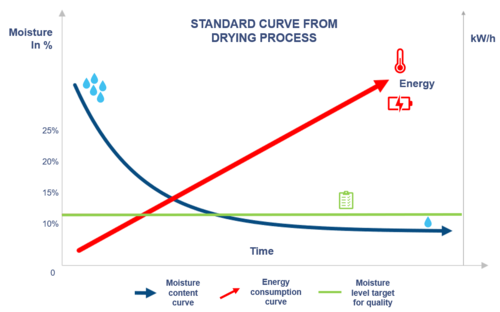
My goal is 5 to 10% moisture in the product. Then I don't need a moisture and density meter?
How important is a moisture measurement when you want to achieve a moisture content of 5 to 10% moisture in your product? Because it is precisely a precise measurement of the water content in your product that ensures that you can save a lot on energy!
Energy saving in the industrial sector
If energy saving is your goal, forget about manual moisture management. Sampling, lab testing and waiting for results are a waste of time and money.
One possibility is an at-line measurement with microwaves for immediate results. Within just one second you know what the exact moisture content is in your product and you can adjust the process.
The more accurate the moisture measurement, the sooner you can stop the process and the more energy you can save. So it's all about a very accurate and fast measurement.
Difference between microtechnology method and other in-line moisture analyzers
Typically, in-line measurement solutions such as capacitive or NIR technology can only provide direct measurements with relative accuracy, as they only measure moisture at the surface of the product. To ensure that the target moisture value is reached, you should wait until most uncertain measurement results are well below the target value (see figure below).
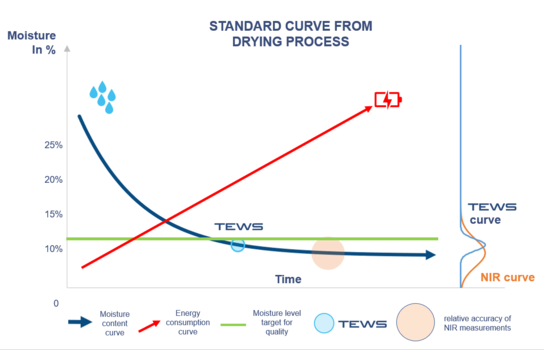
Thanks to TEWS' patented two-parameter microwave technology, both moisture and density are measured deep into the core of the product. This provides more accurate data. This precise method allows you to stop the process earlier, because you are able to measure extremely accurately when the target moisture content has been reached.
Our customers in the wood, paper, pharmaceutical and food industries, all managed to save 6 to 15% of energy depending on the production level and achieved a quick return on investment.
Mr. B. van den Bosch, Director of Production Rombouts Coffee: “With the in-line moisture analyzer from Tews, we have a method to quickly and accurately measure moisture deep into the beans. We can use the results to adjust the process. This saves energy, reduces our carbon footprint and allows us to easily demonstrate that we comply with the legally permitted moisture percentage of less than 5% in the finished coffee.”
More information about energy savings in a drying process in the industrial sector?
Contact the specialists at Inventech via 0162-460404 or visit our website.