SAM GUARD offers advanced predictive monitoring through a combination of AI and HI

SAMSON REGELTECHNIEK offers with SAM GUARD a predictive analytics tool for the process industry. Artificial intelligence (AI) is combined with human intelligence (HI), or the behavior of the entire production unit is supplemented with the knowledge of the process engineers. This makes the tool according to SAMSON an extremely reliable solution, with which unforeseen events are detected early and for the entire plant. The final result is an improved Overall Equipment Efficiency (OEE) and better production reliability. The performance and quality of the factory are optimized to the maximum.
SAM GUARD was originally developed by the Israeli start-up Visual Process under the name Precognize. In 2018, the start-up was acquired by SAMSON and added to SAMSON's product range under the name SAM GUARD.
The product name includes 'SAM' for 'SAMSON ASSET MANAGEMENT'. It is part of SAMSON's growing digital product portfolio. Jos Geers, sales manager at SAMSON, says: “SAMSON already had digital tools to monitor control valves, but the company is well on its way to further digitalization and SAM GUARD fits in very well with that.”
Geers is enthusiastic about the many possibilities of this platform: “The tool is based on something that is often already present in the process industry, a database with stored sensor information, the so-called Historian. This contains a wealth of information, which SAM GUARD uses efficiently. The stored data in the Historian says something useful about the normal behavior of the plant. When you then apply the SAM GUARD method of human enhanced machine learning to this, you gain deeper insights into the current behavior of the factory.
The SAM GUARD team builds together with the end user a complete digital model of the entire factory (assuming 10,000 historian tags) in just two weeks. From that moment on, SAM GUARD is immediately active and monitors the factory 24/7.
“There are all sorts of other platforms that also use machine learning,” Geers continues. These are often based on supervised machine learning and unfortunately not scalable for an entire factory. Many deviations occur randomly. There is no pattern and that simply creates too much noise.
Unsupervised machine learning and human enhancement
That is why SAM GUARD uses unsupervised machine learning. However, that alone is not enough. Suppose you have a factory with approximately 4,000 sensors and you receive an alert every 5 minutes, then you are quickly talking about approximately 250 alerts per day. Nobody has the time to check that. Many of these notifications are also not really relevant from a process-technical point of view, you only create alarm fatigue.”
SAM GUARD solves this problem well: “The extra layer that we add to the baseline machine learning engine, the human enhanced part, gives you a rock-solid formula. Only the process-technically meaningful and therefore relevant alerts remain. That is only 3 to 4 relevant notifications per day for a factory with approximately 10,000 historian tags and that is easy to manage.”
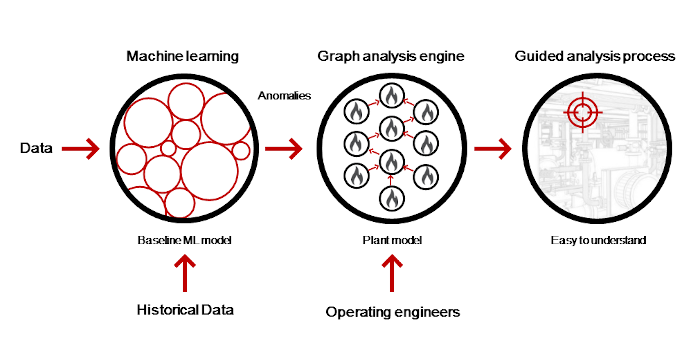
Currently, SAM GUARD is used in the process industry for both batch and continuous processes,” says Geers. SAM GUARD usually runs locally in the factory. This meets IT and cybersecurity requirements, but of course the tool can also run as a cloud service.
Furthermore, according to Geers, no long training is needed to work with SAM GUARD: “It is an intuitive tool. The software is pleasant to work with. Because you only receive relevant notifications, you also build trust with the users. Moreover, this tool clearly shows what exactly is going on, for example by showing the causal relationship between notifications with a graph.”
The results within a factory after implementation of SAM GUARD are sometimes quickly tangible: “We have an example of an ethylene plant, where monitoring was carried out for two months. The customer assigned values to each alert. Within two months, the customer achieved a financial saving of over 150,000 euros. It does indicate that the ROI is good.”
In addition, the tool also indirectly contributes to ensuring that the environment and safety are not compromised, for example in the event of anticipating a flare event or emission from a chemical plant near a built-up area.