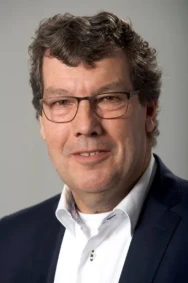
What has FHI membership brought you?
I remember my first FHI meeting very well. I hardly knew anyone, but within an hour I was standing in a circle of entrepreneurs who spoke with the same twinkle in their eyes about technology, innovation, and opportunities. That feeling of 'this is where I belong' has always remained.
Membership has not only brought me knowledge but also people who later became sparring partners, colleagues, and even friends. FHI has broadened my horizons and shown me how valuable it is to be part of a community that helps each other move forward.
When did you first feel that FHI was growing into a connecting force in the technology chain?
That moment is still vivid in my mind. It was during one of the early theme days I was involved in. I saw there how companies came not only to take, but were also genuinely willing to give. Members spontaneously helping each other, sharing knowledge without reservation, and setting up new initiatives on the spot. You could see the energy shifting: FHI was no longer a collection of industries, but a living network in which disciplines reinforced each other and new connections emerged that no one could have planned beforehand. At that moment, I realized that FHI not only facilitates, but can also actually give direction to how the technology chain organizes itself.
Is there a change of course that you think, in hindsight, FHI should have initiated sooner?
Looking back, perhaps we should have recognized sooner that the boundaries between sectors are blurring. True innovation often arises between domains, not within them. If we had embraced that interdisciplinary perspective even earlier—from electronics to laboratory technology and from industrial automation to medical applications—we could have connected some developments more quickly. But frankly: FHI has always had the strength to learn, move, and grow. That is perhaps even more important than the moment you start.
What role do you see for FHI in the coming decades now that technology is becoming increasingly important in our society?
The role of FHI is becoming increasingly important. Technology touches upon societal issues with increasing emphasis: energy, healthcare, safety, sustainability, and ethics. I am reminded of conversations I used to have with members about these themes, which were then still separate islands. Now you see that everything is becoming interwoven. FHI can be the bridge between businesses, government, education, and society. A guide that not only pools knowledge but also organizes dialogue. A place where technical expertise is linked to social responsibility. In that role, FHI can truly make a difference.
Which lesson from the history of FHI do you think every new generation of directors should cherish?
If I were to pass on one lesson from the history of FHI to new board members, it would be this: never underestimate the power of trust!
FHI grew because members were willing to share knowledge, help each other, and stand together in good times and difficult. That requires openness, listening, and the realization that the sector is stronger when people are willing to support one another. Over the years, I have often seen how that trust works. Sometimes a heated discussion would arise during a meeting. That is part of the process when people are involved. But moments later, the conversation continued in an atmosphere of collegiality and respect. Moments like those showed me time and again that differences of opinion are not a threat, as long as the foundation is solid.
That culture of trust and cooperation is perhaps FHI's greatest asset. It is a strength that will continue to make the difference for decades to come.
What message do you want to convey to the current members about the power of collaboration?
I have always viewed collaboration as a source of progress. In a time when technology is becoming more complex and societal expectations higher, you simply can no longer do it alone. By working together, you not only create new opportunities but also build a sector that is future-proof.
I have often seen how collaboration starts with something small: a question during drinks, a spontaneous idea in a workshop, a phone call between two members who want to understand each other just a little bit better. Such moments may seem insignificant, but they often form the seed of major innovations. It shows that collaboration is not a formality, but a mindset. It requires curiosity, openness, and the willingness to share and to acknowledge that your success is connected to that of the sector.
In a world where technology moves faster than ever, collaboration is perhaps our greatest source of stability and innovation. That is why my message to current members is clear: reach out to one another, share what you know, and don't be afraid to think big! That is the strength that has propelled FHI forward for seventy years and that will sustain us for the next seventy years as well.
View the '70 Years of FHI' timeline on our website.