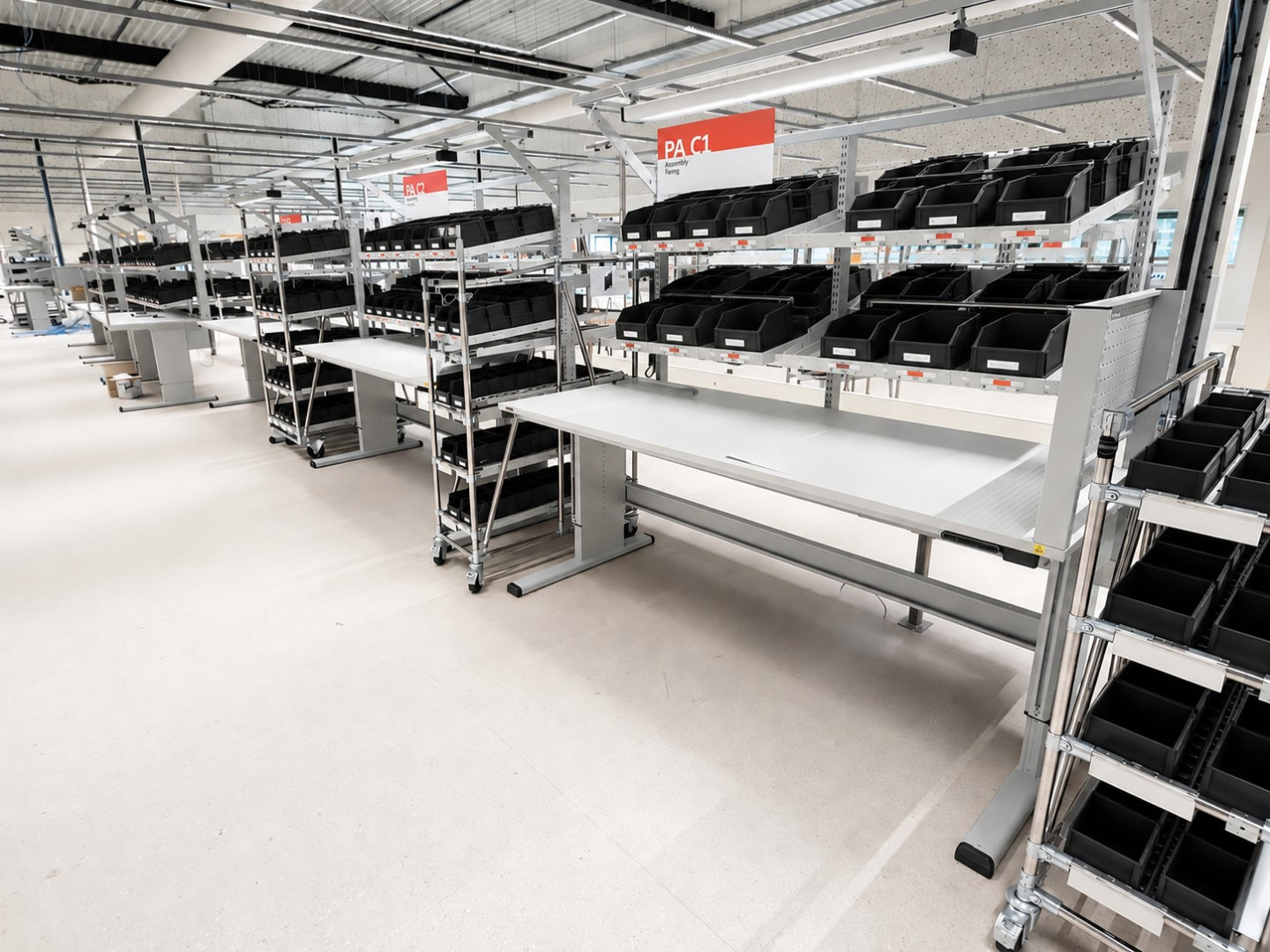

The 2-bin system: simple inventory management for a more efficient workplace
A production worker who has to wait because a part is missing. A mechanic who regularly walks to the warehouse to fetch fasteners. Or large quantities of parts next to the workstation, primarily to ensure that nothing ever runs out. These are recognizable situations that can hinder an efficient flow of materials. A relatively simple LEAN method can help with this: the 2-bin system. With two bins per part, a visual and clear way is created to manage inventory directly at the workstation.
What is a 2-bin system?
The 2-bin system, also known as two-bin Kanban As mentioned, it is a stock management method that uses two bins containing the same part. The employee first uses the stock from the first bin. As soon as this is empty, the second bin is used. The empty bin simultaneously serves as the signal that the stock needs to be replenished.
The principle is simple: Bin 1 in use → Bin 1 empty → Bin 2 in use → Refill Bin 1
This creates a continuous process whereby material is replenished based on actual consumption rather than solely on a schedule.
Why does the 2-bin system fit well within LEAN?
An important principle of LEAN working is reducing activities that do not add value to the process. Examples include searching for parts, unnecessary walking, waiting for materials, or maintaining excessive intermediate stock. With a well-designed 2-bin system, it becomes immediately visible when a part needs to be replenished. This can contribute to:
- less time wasted searching and checking inventory;
- less risk of material shortages at the workplace;
- a clear and predictable material flow;
- less unnecessary stock around the workplace;
- simpler replenishment from the warehouse or internal logistics;
- a tidy and standardized workplace.
The system can therefore be part of 5S, Kanban and Continuous Improvement within production and assembly environments.
A 2-bin system starts with the layout of the workplace.
Simply placing two bins is not sufficient. The location where parts are presented directly influences the employee's actions. Frequently used components should preferably be easily accessible. When an employee has to reach, turn, or walk a long distance for every part, part of the gains from a more efficient inventory process are lost. Therefore, it is worthwhile to examine material supply and ergonomics together.
At a modular assembly workstation can, for example, bin rails, grab bins and material racks be placed above or around the work surface. Frequently used components can be positioned close to the employee. Less frequently used materials can be placed further away from the primary work zone. This creates point-of-use storage: the required material is located where it is actually used.
How much stock should be in each bin?
An important part of a good 2-bin system is determining the correct quantity per bin. Too much stock takes up unnecessary space, while too little stock can still lead to shortages. Factors such as average consumption, fluctuations in demand, and the time required to replenish an empty bin must be taken into account. In principle, the second bin should contain sufficient stock to bridge the period between the replenishment signal and the actual supply. Consequently, the 2-bin system is not just a way to store materials. It is a visually driven supply process.
From loose bins to a standardized workplace
The next step is standardization. When every workstation is set up according to the same principles, it becomes easier for employees and internal logistics to see where materials belong and when replenishment is needed. Consider, for example, fixed positions for bins, item numbers, labels, color coding, and clear agreements regarding the return of an empty bin. Such a setup not only supports inventory management but can also contribute to a clear overview. 5S workplace.
The workplace must be able to change along with it.
Production processes rarely stand still. Products change, volumes fluctuate, and new tasks are added. A workplace that is optimally organized today may no longer be so in a year's time. That is precisely why a 2-bin system fits well with a modular workplace design.
In modular assembly workstations, bins, shelves, lighting, tool holders, and other accessories can be repositioned when the process changes. The number of bins and the layout of the material supply can also be adjusted. This prevents the need for a completely new workstation with every process improvement.
2-bin as part of Continuous Improvement
The strength of the 2-bin system ultimately lies not in the bins themselves, but in the way the system is used to provide insight into the process. Do shortages occur regularly? Are certain bins hardly used? Is there too much stock? Does an employee often have to move outside their normal reach? These are signals that can be used to further improve a workplace. In this way, a simple 2-bin system can be a practical starting point for Continuous Improvement. Not only by organizing inventory more intelligently, but by continuously monitoring material flows, operations, and ergonomics.
An efficient workplace is more than a work table.
At Human Workspace, therefore, we do not just look at the work table itself. We look at the activities that take place on and around the workplace. Which items does an employee use? How often? Where are they provided? What movements are required for this? And how is the workplace supplied?
Based on this, a modular workplace can be set up whereby ergonomics, material supply and efficiency come together. Treston's modular workplace systems offer many possibilities for positioning bins, tools, lighting, and other necessities around the employee.
In this way, the workplace becomes part of the process – and can continue to grow with future improvements.
Frequently asked questions about the 2-bin system
What is a 2-bin system?
A 2-bin system is an inventory management method that uses two bins containing the same part. As soon as the first bin is empty, the second is used, and the empty bin serves as the signal to replenish stock.
Is a 2-bin system the same as Kanban?
The 2-bin system is a simple application of the Kanban principle. Material consumption determines when new stock is replenished.
For which materials is a 2-bin system suitable?
The system is particularly practical for frequently used parts and consumables, such as fasteners, electronic components, and small assembly parts.
What does the 2-bin system have to do with LEAN?
The system can reduce waste by replenishing materials based on actual consumption. This reduces waiting, searching, unnecessary movements, and excess inventory, among other things.
Can a 2-bin system be used at an assembly workstation?
Yes. By placing bins on bin rails or material racks around the workplace, parts can be made immediately available at the point where they are used.
How do you combine a 2-bin system with ergonomics?
By positioning frequently used parts within a comfortable reach zone. The correct placement depends on the work activities, frequency of use, and properties of the material.
Request no-obligation advice
Would you like to know how our assembly tables and lines can make your process future-proof and LEAN? Contact our specialists for personalized advice.