Plastic waste processing and recycling – Mixers and dryers support sustainability
Plastic waste processing and recycling
Mixers and dryers support sustainability
Introduction
Energy-efficient mixers and dryers are widely recognized as important tools to support manufacturers' sustainability goals by reducing production-related emissions. What is less well known is that these technologies also contribute to circularity by being part of processes that convert plastic waste into valuable raw materials.
This article takes a closer look at how mixing and drying technology supports various routes for polymer recycling, so that the rapidly growing amount of plastic waste can be valorized and reused.
Energy-efficient technology as part of recycling processes
Modern high-performance mixers and dryers are designed with energy efficiency as a starting point. Efficient heat transfer, low specific energy consumption, and the ability to recover process heat contribute not only to lower operating costs but also to more sustainable production processes. Less visible is their contribution to sustainability through their role in processes that recycle or upgrade waste streams.
The benefits of recycling
“Besides energy, recycling is nowadays an important part of the sustainability strategy of many companies,” says Marc Jacobs, Team Manager Chemicals/Minerals/Metals at Hosokawa Micron BV. “This is often economically attractive as well. When you can reuse material from your own process, you directly reduce the consumption of raw materials and the costs of waste processing.”
As a designer and builder of mixing, drying, and agglomeration systems for powders, particles, and bulk materials, Hosokawa Micron, based in Doetinchem, has been supporting recycling processes in various industries for many years. For instance, about ten years ago, the company modified one of its Nauta mixers for a biscuit manufacturer. Thanks to a relatively small adjustment to the mixing screw, unmixed dough could be discharged at the bottom of the mixer and reintroduced at the top. “With this ‘internal recycling loop,’ more material remained in the process, and the amount of waste at the customer’s site was significantly reduced,” explains Jacobs.
Plastic production doubled
The polymer industry in particular is under increasing pressure when it comes to waste reduction and recycling. According to the report Global Plastics Outlook According to the Organisation for Economic Cooperation and Development (OECD), global plastics production has more than doubled in the past twenty years: from 234 million tonnes in 2000 to 460 million tonnes in 2019.
This results in more plastic waste than traditional waste processing systems can handle, with negative consequences for the environment and climate. To limit this impact, many governments are introducing stricter regulations that encourage companies to recycle or upgrade polymers. For example, the new European Packaging and Packaging Waste Regulation (PPWR) requires that all packaging on the EU market must be recyclable by 2030. In addition, minimum percentages of recycled material are mandated for plastic packaging, ranging from 10% to 35%.
Solutions for various recycling routes
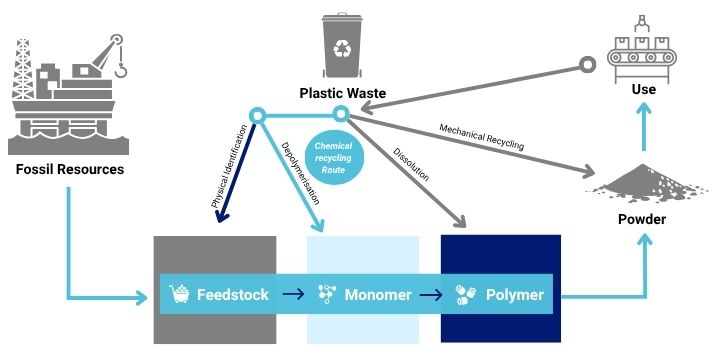
In addition to mechanical recycling – the most common method in which plastic waste is sorted, cleaned, shredded, melted, and reformed while preserving the original polymer structure – there are various other techniques for the reuse of plastics. Examples include dissolution processes and pyrolysis or gasification.
Solving plastic-rich waste streams
Whether plastic waste can be recycled or upgraded, and which method is most suitable, depends heavily on the composition of the waste stream. Waste streams with a high plastic content (more than 80% polymers), for example, can be processed via a dissolution process.
In this process, a solvent is used to dissolve polymers. Undissolved impurities can then be mechanically separated and removed. Subsequently, the polymer is recovered by evaporating the solvent under vacuum.
“Our vacuum dryers – based on Nauta technology or the Central Paddle Dryer (CPD) – can be applied in this process,” says Jacobs. “By operating at reduced pressure and relatively low temperatures, thermal degradation is prevented, while still achieving high residual solvent removal.”
The recovered polymer material is subsequently prepared for pelletization via an extruder.
Homogeneous mixing of additives
Blending technology also plays an important role in the production of additives used to upgrade recycled polymers. For example, some Nauta® mixers from Hosokawa Micron for years part of production lines at manufacturers of plastic additives for the polymer and recycling industry.
Within this production line, peroxide masterbatches are produced, among other things, which are used in the recycling sector to reduce the viscosity of polymers.
“To guarantee consistent product quality, the plastic additives must be mixed into a completely homogeneous mixture,” says Raymond Fels, Application Engineer CMM at Hosokawa Micron. “Moreover, this mixing process must take place without excessive heat generation, because the ingredients used are temperature-sensitive.”
The applied Nauta® mixer from Hosokawa Micron combines efficient homogenization with relatively low heat input. In addition, the system is simple and safe to operate, reliable in a continuous feed to extrusion lines, and low-maintenance in industrial production environments.
Pyrolysis for mixed plastic streams
For mixed or heavily contaminated plastic waste streams, pyrolysis – also known as gasification – can offer a solution. In this process, the waste is heated without oxygen and converted into oil and gas, while a solid residue remains. This residue contains mineral components such as calcium carbonate and titanium dioxide. As a result, reprocessing for reuse is more complex, but not impossible.
“Pyrolysis is also used, for example, to produce recovered Carbon Black (rCB) from car tires,” says Jacobs. In this process, after pyrolysis, the granules are first pre-shredded and then finely ground. This is followed by the pelletizing process, in which a mixer is used to add a binder and a dryer to convert the wet pellets into dry, stable, and easy-to-handle pellets.
“Together with our sister companies Hosokawa Alpine and Hosokawa Solids, we supply all the equipment required for this process and have already developed various cost-efficient total systems for Carbon Black recycling,” explains Jacobs. “For plastics recycling, this technology is still in a relatively early stage. But if you look at the development of the rCB market over the past fifteen years – from technically feasible to economically viable – I see no reason why a similar development could not also take place for polymers.”
More sustainable and economically more attractive
“The processing and recycling of polymer waste is a complex field for which no standard solution exists,” says Fels. At Hosokawa Micron, he and his specialist colleagues are always open to customer ideas and to jointly exploring potential solutions in which mixing and drying technology can play a role. “Based on our process knowledge, we can determine which technology is most suitable for a specific application. We can then validate this through pilot tests in our Test Centre.”
“Polymer recycling is a very dynamic and urgent subject. Our mixers and dryers are already part of various process steps at companies involved in polymer recycling. We are happy to help them make these processes even more sustainable and economically attractive,” concludes Jacobs.