What if a hacker determines the temperature of your cooling system?
Recent cyberattacks on cooling systems show how vulnerable connected industrial systems can be. What does this mean for manufacturing companies and machine builders? And how do you keep remote access secure?
On November 2, 2026, cooling systems at at least 17 Dutch companies were digitally disrupted. Supermarkets and other businesses in Belgium, Sweden, and various other European countries were also affected. Attackers managed to gain access to control systems and adjusted temperature settings, among other things.
The consequences can be significant. For companies that rely on refrigeration, such a disruption can lead to spoiled products, production losses, and food safety issues.
What makes these attacks striking is that complex hacking techniques were not always required. According to initial reports, several affected systems were directly accessible via the internet and secured with default passwords.
Remote access: indispensable, but not without risk
For machine builders and manufacturing companies, remote access has become commonplace. A service engineer can analyze a malfunction without traveling to the customer, machines can be continuously monitored, and software updates can be performed remotely.
These capabilities save time, limit downtime, and make maintenance more efficient. However, the same connection that gives a service technician access to an installation can also serve as an entry point for unauthorized persons if insufficiently secured.
This deserves extra attention, especially in production environments where machines often remain operational for years. Control systems and controllers are not always designed with current cybersecurity risks in mind. Moreover, outdated software, unnecessarily open network connections, and inadequate access control can cause vulnerabilities.
Completely disabling remote access is usually not a practical solution. The challenge is to retain the benefits of connectivity without unnecessarily exposing machines to risks.
How well is your remote access secured?
The recent incidents provide a good opportunity to review the security of existing installations. The National Cyber Security Centre ( ) advises organizations, among other things, not to make systems directly accessible via the internet, to use strong passwords, and to perform security updates in a timely manner.
Five points of attention for machine builders and production companies:
1. Check which installations are accessible from the outside
Map out which machines, controllers, and other industrial systems are connected to external networks. Check whether direct internet access is necessary and remove unnecessary connections.
2. Limit who has access
Not every employee, supplier, or service partner needs access to all systems. Work with personal accounts, appropriate access rights, and multifactor authentication (MFA). Revoke access rights as soon as they are no longer needed.
3. Keep software and firmware up to date
Regularly check whether security updates are available for controllers, gateways, and other network components. Align updates with the production schedule and take into account the potential impact on the installation.
4. Ensure insight into external connections
Do you know who currently has access to your machines? Record which users connect, when this happens, and which systems they have access to. This makes it easier to identify and investigate suspicious activity.
5. Make cybersecurity part of the machine design
For machine builders, secure remote access does not begin only at delivery. By taking network segmentation, access control, and secure communication into account during development, risks can be structurally mitigated.
Secure remote access without compromising accessibility
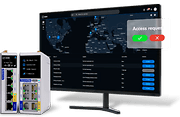
A well-secured connection does not have to come at the expense of ease of use. With an industrial remote access solution, machine builders and production companies can centrally manage and better control remote access.
An example of this is , a platform for industrial connectivity and remote access.
IXON uses a secure connection from the machine to the cloud platform.
As a result, no incoming ports need to be opened in the local firewall for this access. User roles and access rights determine who is allowed to connect to which machine. The platform also supports multifactor authentication and logging of remote access.
Moreover, with additional features, end users can determine for themselves when an external service provider gains access to their installation.
With this, IXON offers options to keep remote maintenance and service accessible, while improving control over external connections.
It remains important, however, that a secure connection is only one part of industrial cybersecurity. The connected controllers, network configuration, and the management of users and updates must also be properly secured.
Cybersecurity starts with insight
The attacks on cooling systems demonstrate that digital vulnerabilities can have direct consequences for physical production processes. And that risk is not limited to cooling systems. Any industrial environment where machines are accessible remotely requires deliberate access management and appropriate security measures.
For machine builders and production companies, this is therefore a good time to critically review existing connections.
Do you know who has access to your machines, and how that access is secured?
Routeco helps machine builders and production companies find suitable solutions for industrial connectivity and secure remote access. Together with technology partners such as IXON, we examine how remote access can be set up reliably, manageably, and securely.