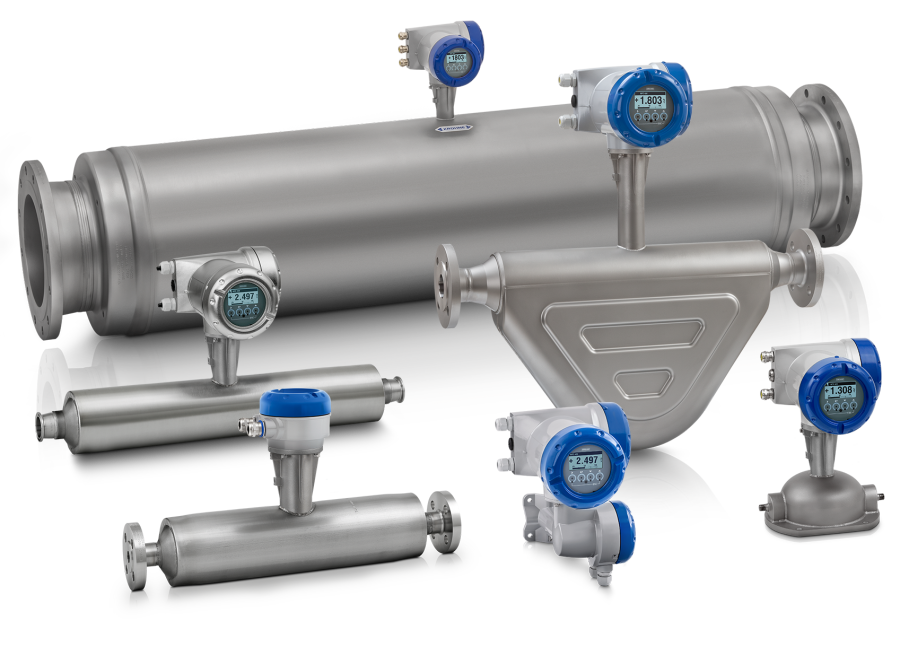
In the process industry, a reliable flowmeter has become indispensable. This is especially true when working with (difficult) liquids, gases, or mixtures. Consider products with high viscosity, varying composition, or trapped air or gas. For these types of applications, a straight tube mass flow meter developed: simple, but very robust and accurate. In addition to mass and volume flow measure the meter also the density of the product. This is particularly useful for quality assurance, product identification, or process control. You see immediately when the product deviates.
When choosing a Coriolis mass flow meter, the design of the measuring tube plays an important role. Traditionally, many mass flow meters are equipped with curved tubes (U- or Ω-shaped), because this geometry makes the Coriolis effect relatively easy and accurate to measure. Nevertheless, the straight-tube mass flow meter, as used in modern instruments, is gaining increasing ground.
The most important advantage of a straight tube is the unobstructed flow. Because there are no bends, there is less pressure loss and product accumulation is prevented. Even with viscous media, the pressure drop remains as low as possible. This is beneficial for your process and saves energy. Furthermore, the pipe is easy to clean completely and can often be designed to be self-draining, which is important for CIP and SIP processes.
In addition, a straight tube performs better at media with solid particles, fibers, or risk of contamination. Unlike curved tubes, where deposits can form in bends, the flow profile in a straight tube remains more homogeneous. This results in more stable measurements and less maintenance.
However, curved Coriolis meters retain their value in applications where maximum accuracy at low flows and a compact installation length is required. The choice between the two designs is therefore always a trade-off between hygiene, maintenance, pressure loss, and measurement sensitivity.