Animal-free breakthrough in organoid cultivation
By: Hans Risseeuw

On Tuesday, May 19, 2026, Joost Wijnakker will open the first edition of FHI Life Sciences Live in the Plus Ultra building on the Utrecht Science Park Campus. This new morning event is specially designed for everyone working in life science research and laboratory applications.
Joost Wijnakker received his PhD from Utrecht University on November 24, 2025, with a thesis that represents a significant step toward fully animal-free and defined organoid culture. His research, conducted within the Clevers group under the supervision of Hans Clevers and Patricia Dankers, focused on breaking a persistent reliance in the organoid field: the use of Matrigel, an animal product derived from mouse tumors. Although Matrigel has been indispensable for culturing organoids for years, it has significant drawbacks, such as batch variation, high costs, and its unsuitability for clinical applications.
Integrins key to growth
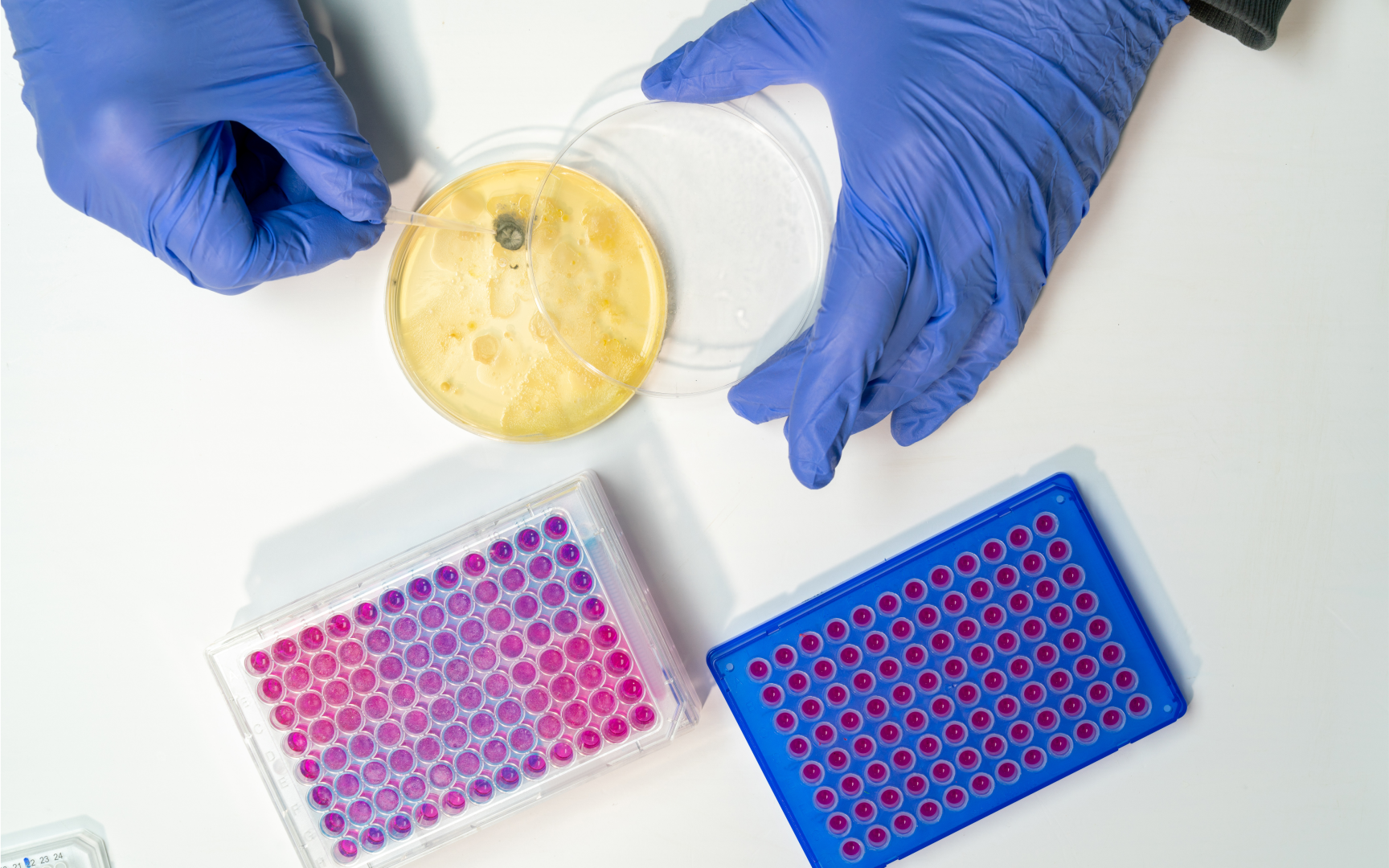
Organoids, mini-organs grown from human stem cells, are invaluable for fundamental research, disease models, and drug development. To make this technology future-proof, an animal-free alternative is essential. Joost therefore started with the basics: understanding the signals stem cells need to grow and organize. The role of integrins proved crucial. Integrins are receptors that allow cells to sense and respond to their environment. By collaborating with experts, he was able to demonstrate that integrin β1, in particular, is essential for the growth, orientation, and survival of organoids.
An unexpected ally: bacteria
This insight led to an unexpected breakthrough. Joost discovered that a small fragment of the bacterial protein Invasin can activate multiple integrin β1 receptors simultaneously. Unlike natural matrix proteins, which usually only target a single receptor, Invasin acts as a powerful "superagonist" that combines multiple signals. In 2024, he demonstrated that this protein can grow organoids in a 2D environment on flat surfaces, without the use of animal material.
Reliable and future-proof
He then moved on to 3D culture by combining Invasin with a fully synthetic gel (PIC gel). This allowed organoids to grow three-dimensionally, similar to culturing in Matrigel, but completely animal-free and more controllable. In this system, organoids proved to grow well, retain their structure, and be sustainable for extended periods. This created a fully synthetic and reproducible alternative to existing animal matrices.
With his PhD research, Joost has taken a clear step toward an animal-free perspective for organoid cultivation. He believes the technology is ready for broader testing and application. What began as fundamental research into cell-matrix interactions has the potential to become a new standard in the field.
On Tuesday, May 19, 2026, you'll start your day with other life science professionals during the first edition of FHI Life Science Live. View the program and register at the website.