Chips as a strategic raw material: how Lifeport aims to double its chip production by 2034

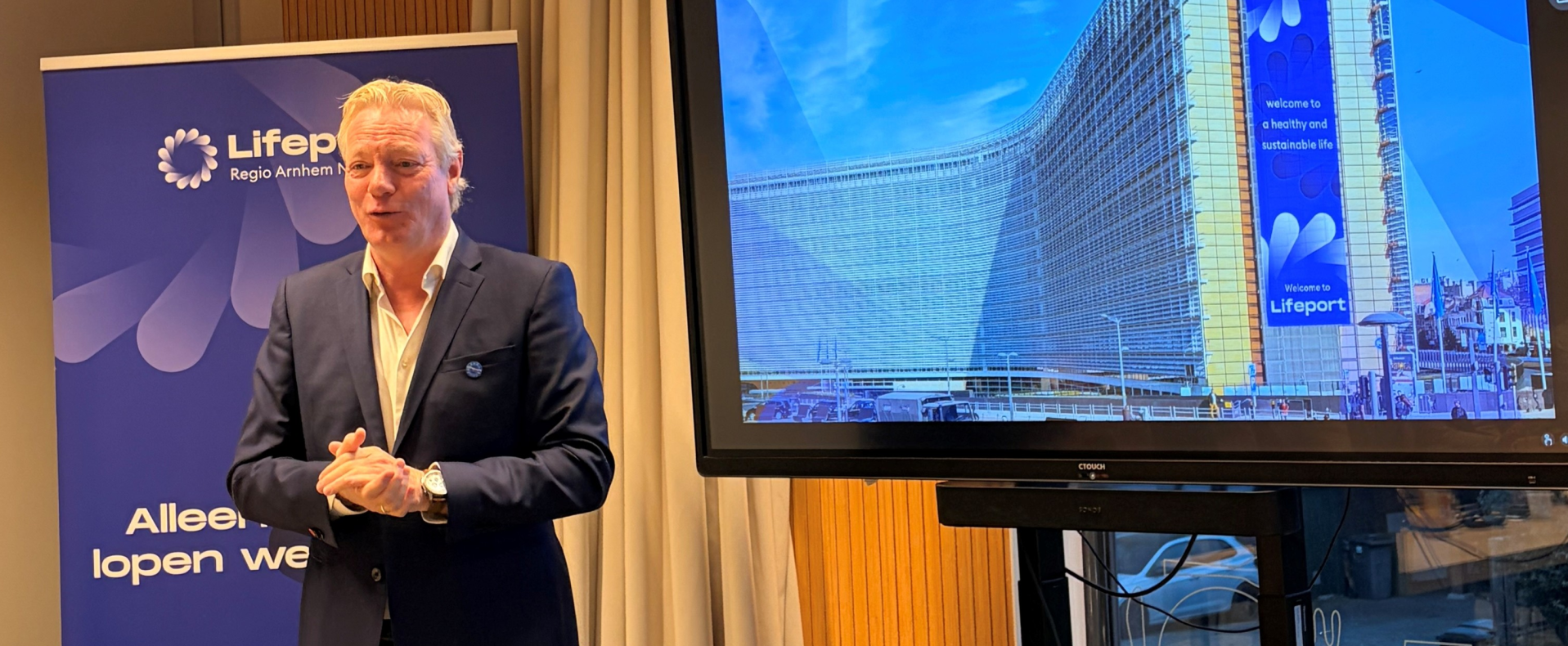
Can Arnhem-Nijmegen grow into the Silicon Valley of the Netherlands? Jan van Dellen thinks so. As director of Lifesport Region Arnhem Nijmegen and The Economic Board, he sees the regional semiconductor sector expanding at a rapid pace. During the technology fair WoTS In 2026, he explained why this particular region occupies a unique position within the EU: “We possess a complete semiconductor chain, a rarity in Europe.”
Chips form the basis of virtually every modern technology, but the dependence on production capacity outside Europe is still significant. And that is dangerous, according to Van Dellen. “During the corona crisis, we saw what the consequences can be if the supply of raw materials from Asia stagnates. The economic damage is not even the biggest problem; access to semiconductors is also a geopolitical issue. Without semiconductors, communication networks grind to a halt, and we cannot access our data, energy systems, or AI platforms.”
Business resilience
To strengthen the resilience of the business community, it is essential to minimize dependence on non-European countries. Van Dellen sees a key role for Lifeport in this regard, as part of the 'semicon axis', which runs from Enschede, via the Arnhem-Nijmegen region and Eindhoven to Leuven (Belgium).
“Our region possesses both research and development capacity and large-scale industrial production. Moreover, there is an extensive ecosystem of international players present, including NXP, Nexperia, Ampleon, Besi, and ASMPT ALSI, and research and educational institutions are located in the region. A large proportion of these, 55 organizations in total, collaborate under the umbrella of Lifeport.”
More than just research
A complete value chain within a single region offers a competitive advantage for the industry and therefore attracts even more companies, according to Van Dellen. “The economic influence of the semiconductor sector in this region will only increase in the coming period. By 2026, the cluster in the Lifeport region will represent an annual turnover of approximately 3.5 billion euros. The ambition is to grow to a turnover of about 8 billion euros in 2034.”
To achieve these ambitious goals, approximately 1.1 billion euros are needed. This financing must come from a combination of private investments, national stimulus programs, and European funds. The money is intended, among other things, for expanding production capacity, research, innovation, infrastructure, and talent development. “In fact, it is a no-brainer "When you consider how much the expansion of our industry will yield in the future relative to the initial investment," said the engineer.
Biggest challenge
Attracting sufficient technical talent is a major challenge. Van Dellen explains: “The desired growth requires a substantial influx of operators, engineers, researchers, and technical specialists. Without sufficient personnel, our expansion plans risk stalling.” To prevent this, companies, educational institutions, and government bodies are collaborating within a regional talent program that aligns with the National Microchip Talent Strengthening Plan.
“According to the so-called 'triple helix model,' parties jointly assume responsibility for the economic and technological development of the region. We try to think creatively in this regard. For instance, a pilot is currently underway to enable asylum seekers with a technical background to enter technical positions through targeted training. Free retraining courses are also available for potential lateral entrants.‘
European position not self-evident
Van Dellen concludes that the Netherlands already holds a strong position within the global semiconductor industry, but that this position is not guaranteed. To maintain the current competitive position, it is necessary to invest in technology, production capacity, and human capital over the long term. For the Arnhem-Nijmegen region there lies an opportunity not only to expand, but to become a frontrunner in the European semiconductor sector.