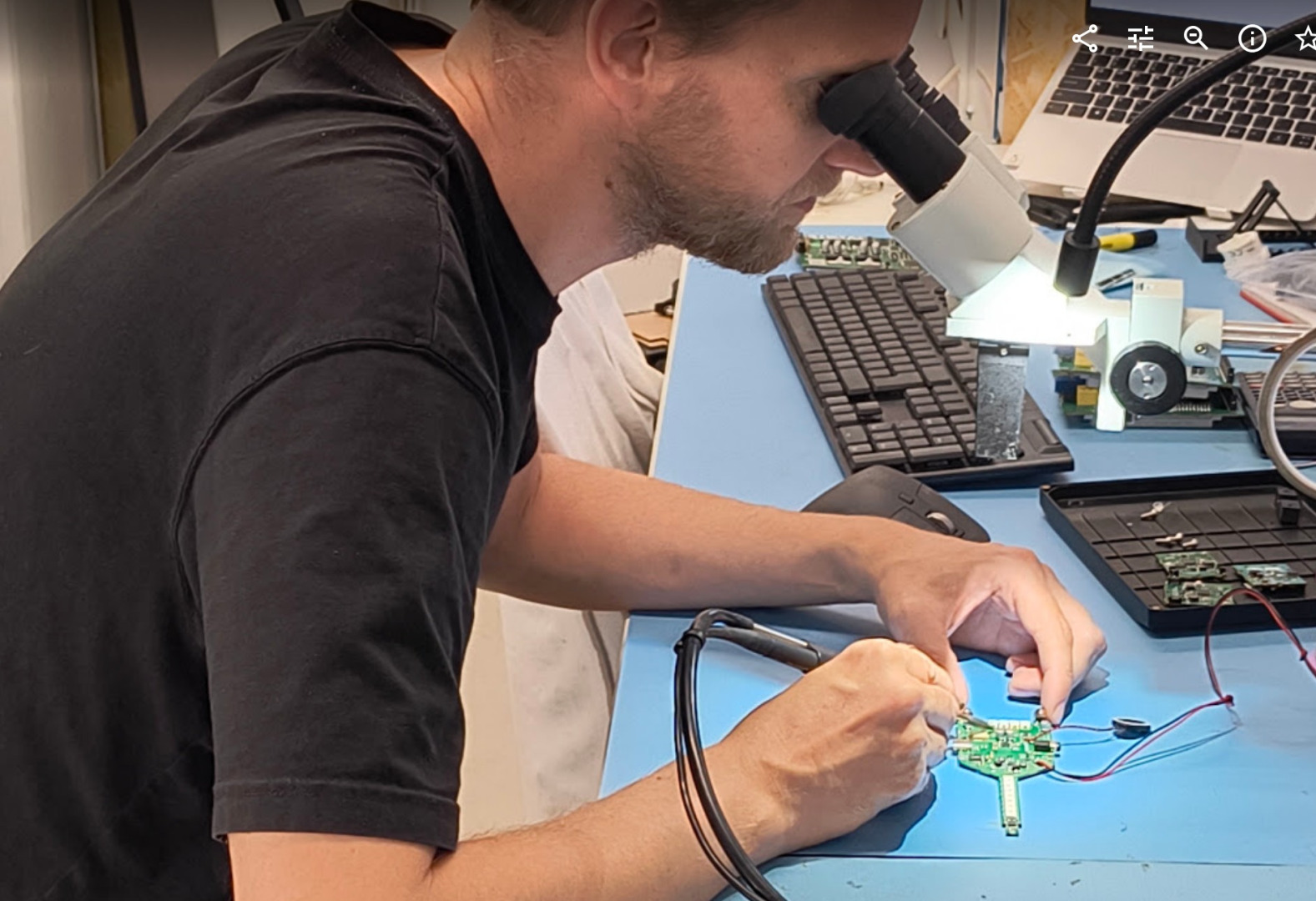
Taking a closer look at the stock market gadget: seeing and hearing radiation with the EMI Sniffer

Designing a gadget that doesn't disappear into a drawer after the trade show, but remains on the workbench for years to come. With that ambition, startup EVAbits developed the EMI Sniffer: a device that makes electromagnetic interference (EMI) both visible and audible. The result is impressive, as the EMI Sniffer has been chosen as the trade show gadget for WoTS 2026, World of Electronics.
“The power of the gadget lies in the combination of functions,” says engineer Arjen Bogerman, co-founder of the Groningen-based test and development company. “On the one hand, there is the playful element: if you move it past electronics, LEDs light up and you hear sound. On the other hand, it has a clear technical application, namely detecting EMI.”
Estimate hotspot
Identifying EMI is important during the electronics design process. Products must meet European electromagnetic compatibility (EMC) requirements to obtain a CE marking. Excessive emission can lead to interference with other products, resulting in the rejection of the final product. “Normally, these types of measurements take place in specialized test chambers with calibrated equipment,” explains Bogerman. “That is expensive. The EMI Sniffer does not offer a certified measurement, but it does provide an accessible indication. You can quickly estimate where a hotspot is located.”
How does the EMI Sniffer work?
“You can recognize an EMI hotspot by the LEDs that light up and the accompanying sound. The more LEDs that light up, the stronger the radiation. The sound is an auditory representation of the type of EMI. After all, every type of radiation has a different tone; with a drill, for example, you hear a 'whining' sound, while with radio interference you perceive a shrill tone. This way, you can see and hear whether the electronics are well-designed.‘
The gadget features a minimalist analog front-end. This was a deliberate choice, according to Bogerman. “The input signal is first boosted and then converted via a peak detector into a DC envelope that can be sampled directly by the ADC. The firmware translates the signal strength into a dynamic LED bar, exactly as you would expect from a classic VU meter.”
“The built-in coil picks up interference signals from the environment and sends them, after amplification, to a mini-speaker. So you not only see the amplitude, but you also listen to the electromagnetic noise around you.”
Build and test it yourself
An important principle in the development is its educational character. “The gadget is an accessible entry tool into the world of testing and measurement. Our goal was to make a complex subject like electromagnetic interference tangible and fun.”
During WoTS, visitors build the device step by step, program the software, and test the final result. For the first time, it is also possible to have the gadget calibrated on the exhibition floor. Bogerman: “This allows us to provide insight into the entire process behind the gadget.”
Collaboration as the key
The development of the EMI Sniffer is not a solo initiative. Dozens of parties are contributing: from printed circuit board manufacturers to assembly partners, and from component suppliers to enclosure specialists. This collaboration requires coordination, but it also yields significant benefits. “You get to know new people and your network grows. Moreover, you discover how parties react under pressure and with whom you want to collaborate more often in the future,” concludes Bogerman.
More than a nice little thing
The EMI Sniffer proves that the WoTS gadget is more than a nice souvenir. The device connects technology, education, and collaboration in a single concept and makes an abstract phenomenon like EMI accessible to a broad audience.
Visitors who wish to obtain a copy can register free of charge. to register via the WoTS website and express your interest. The organization is producing a maximum of 1,500 units. It is first come, first served. The EMI Sniffer can be picked up at the World of Electronics in Hall 8.