From robotics to industrial automation: servomotors as the driving force behind precision motion
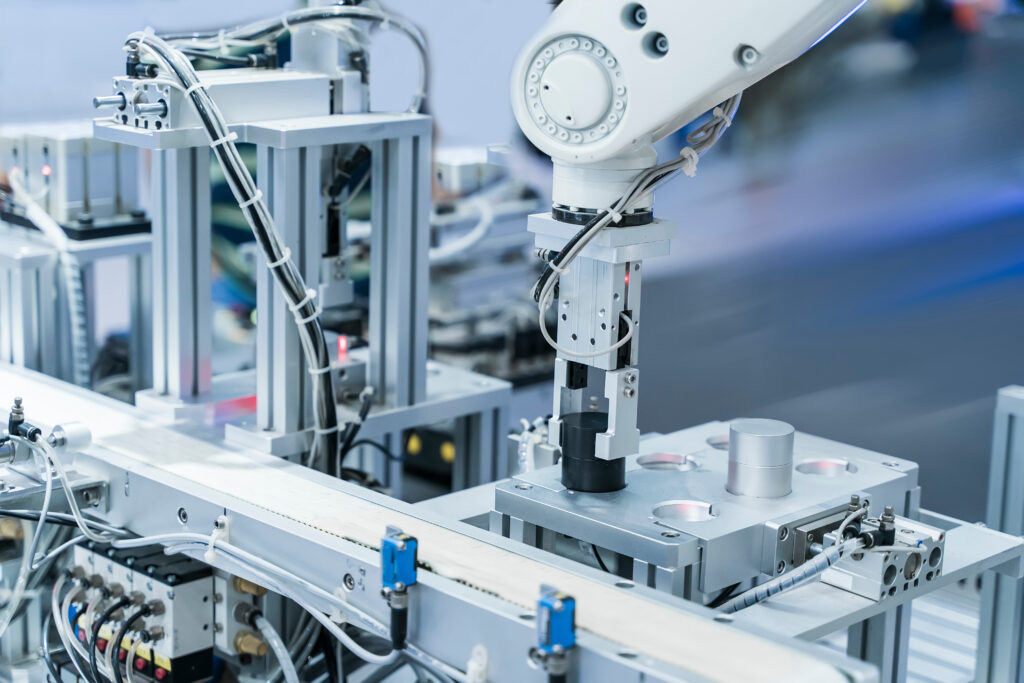
A robotic arm that picks up and places a chip with micrometer precision. A medical robotics system that performs surgical movements with an accuracy a human hand cannot match. A defense system that corrects heavy vehicle positioning within milliseconds. What all these applications have in common is that the movement behind them does not simply require power; it demands precision, dynamics, and reliability. And that is exactly where servo motors prove their strength.
In this article, we take you through the world of servo motors: what distinguishes them from other motor types, in which sectors they are indispensable, and why choosing the right servo drive makes the difference between a system that works and a system that excels.
What makes a servo motor different?
Where a DC motor or stepper motor While a servomotor serves well in applications that run without the need for continuous correction, it is fundamentally different: it works with feedback. An encoder continuously measures the actual position, speed, and torque, and the control corrects in real time to the set target. That closed system – the closed loop – is what gives servo motors their exceptional accuracy and dynamics.
The result: a motor that not only rotates, but knows where it is rotating, how fast, and with how much force. And that corrects itself time and again as conditions change. Think of a robotic arm whose load varies – full, empty, heavy, light – and where the movement must still remain constant, smooth, and safe.
Where servo motors are indispensable: five sectors
Servomotors are deployed where requirements for precision, dynamics, and compactness are above average. Within the sectors served by Zilvertron, we see them playing a central role in an increasing number of locations.
Medtech & robotics
In medical equipment and robotics, precision is not a luxury, but a strict requirement. Robotic surgical systems, automated laboratory systems, precision dispensers—they all rely on servo motors that perform movements with a repeatability in the order of micrometers. But it does not stop at precision: in medical environments, strict requirements also apply to hygiene, silence, and reliability. A servo motor that operates vibration-free and without interference is not a detail here, but a design requirement. Within our robotics segment we supply servo motors and related amplifiers helping OEMs achieve these performance levels – with engineering support from our own R&D team where necessary.
Defense & heavy vehicles
In defense and heavy vehicle applications, robustness under extreme conditions is paramount. Servomotors are deployed here for positioning systems, aiming mechanisms, and actuator control—applications where shock, vibration, and temperature extremes are commonplace. The feedback loop of a servomotor here is not just a matter of precision, but of safety: deviating positioning can have far-reaching consequences. This requires components with the appropriate IP protection rating, materials that resist corrosion and wear, and a delay which the couple translates into the strength that is needed – without playful abstraction.
Semiconductor equipment
In the semiconductor industry, tolerances are at a level virtually every other sector dreams of. Waffer handling, positioning of lithography systems, nanopositioning – this requires servo motors that are not only accurate, but remain accurate. Moreover, in a cleanroom environment, restrictions apply regarding particle emission, magnetic interference, and heat generation. The servo drive must perform without contaminating the environment. A challenge where standard components often fall short and where customer-specific engineering makes the difference.
Agricultural technology & aqua horticulture
Perhaps not the first sector that comes to mind when it comes to servo motors, but the reality is that modern agricultural systems and aqua-horticulture installations increasingly require regulated, precise movement. Consider dosing systems, positioning of jigging systems, and automatic sorting and transport lines. The environment is hostile – moisture, dust, biological corrosion – yet the movement must remain smooth and accurate. Here too, the principle applies: the right motor with the right protection rating, coupled with a control and power supply that work reliably in practice.
Intralogistics
In intralogistics, it is about speed and accuracy: sorting systems, conveyor drives, automated guided vehicles (AGVs), pick-and-place units. Servomotors enable the high dynamics required by modern logistics processes—acceleration, deceleration, positioning—time after time, without loss of performance or reliability. The integration with HMI panels and controls makes it possible to coordinate multiple axes and control the system from a single interface.
AC or DC servo: the right choice for your application
Within our servo motor range, we distinguish between AC and DC servo motors, each with its own strengths that determine where they perform best.
AC servo motors They are often deployed for higher power outputs and higher dynamic performance. They are robust, deliver high torque, and are ideally suited for continuous operation in industrial environments. Their efficiency and power density make them the standard choice in many production and automation environments.
DC servo motors They excel in compact applications where space is limited and the motor must operate directly at lower voltage levels. Think of battery-powered systems, medical equipment, or vehicle applications. The combination of a compact design and precise control makes them particularly versatile.
The choice between the two is not a preference, but an application decision. And that is exactly how our engineers handle it: not starting from a product, but from the movement requirements of your system.
Servomotor, control, and amplifier: the system behind the motor
A servomotor never performs alone. The motor is one part of a trio that together forms the servo system: motor, amplifier and control. The amplifier – also called a drive or amplifier – translates the signal from the control unit into the current required by the motor. The control unit coordinates the movement: trajectory planning, position stroke, speed control, and torque limiting.
When these three components are not aligned, the result is a system that works on paper but vibrates, overheats, or becomes unstable in practice. It is precisely this alignment—bringing together motor, amplifier, and control system into one coherent, functioning whole—where Zilvertron delivers its added value. Not by supplying components and leaving the integration to the customer, but by thinking along from the design stage.
Energy efficiency: performance without waste
A trend that is gaining increasing momentum in all these sectors is the demand for energy efficiency. Not only for sustainability reasons, but also because energy consumption directly affects heat generation – and heat generation in a servo system means a loss of performance and additional cooling infrastructure. Modern servo motors and intelligent controls help address this problem by optimizing energy consumption without compromising dynamics or accuracy. The result: systems that are not only more precise, but also more efficient and reliable over a longer lifespan.
From component to complete solution
The difference between a servomotor that rotates and a servo system that truly performs lies in the integration. Motor, amplifier, control, gearbox, power supply – every component must be matched to the others, and to the environment in which the system operates. That is where Zilvertron distinguishes itself. With more than 30 years of experience in precision drive technology, and its own R&D department with mechanical and electronic engineers. And a product range that encompasses the complete servo system: from motor to amplifier and control. We help OEMs in medtech, defense, semiconductor, agricultural technology, and intralogistics to turn a collection of components into a reliable, integrated system.
Whether it concerns a standard solution from our catalog or a customer-specific developmentYour application takes center stage. Not the motor, not the brand – the movement you need, and the reliability with which you want to achieve it.
Would you like to brainstorm about a specific servo application in your system? Contact our sales engineers – we are happy to brainstorm with you, without obligation and based on technical expertise. Or come visit us in Schoonhoven, and we'll have the coffee ready and look at your movement needs together.