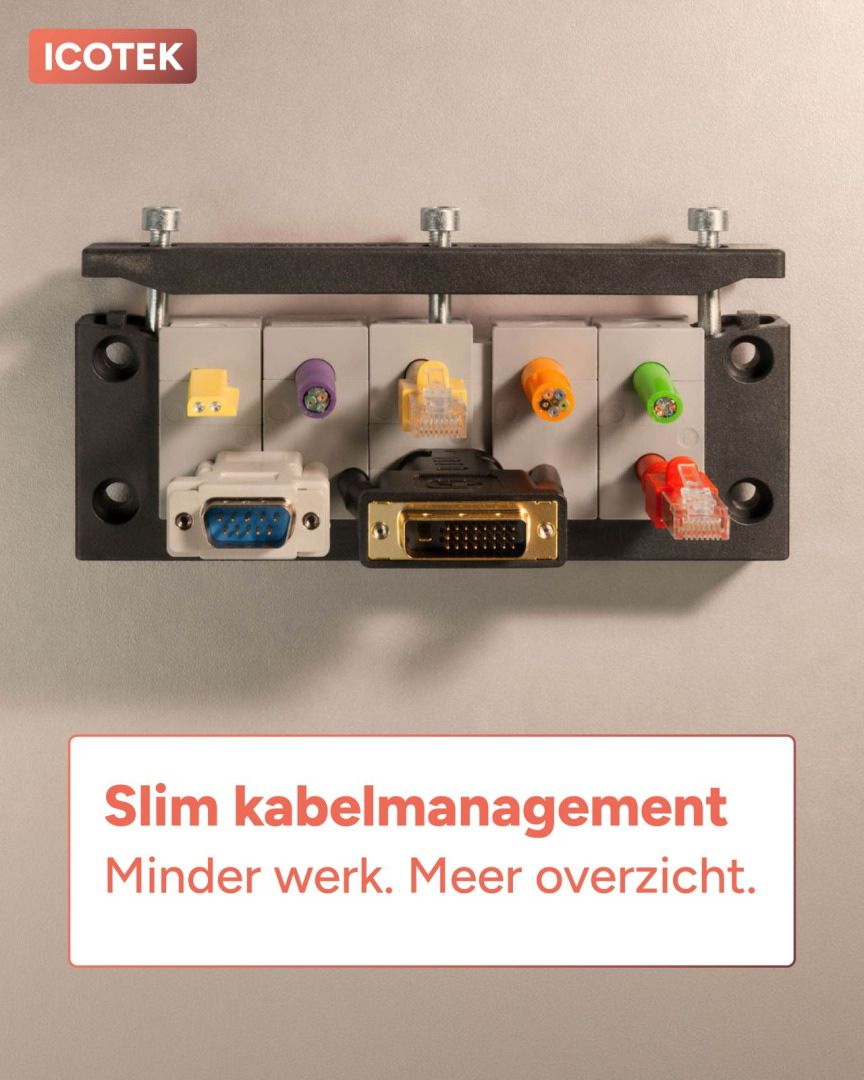
Cable entry: small component, major impact on machine construction
Cable routing may seem like a small detail when designing a machine or control cabinet. In practice, however, the chosen solution has a significant impact on assembly time, space utilization, flexibility, and the final protection rating of the cabinet.
Whereas in the past a separate cable gland was often used for each cable, nowadays there are smart cable entry systems that allow multiple cables to be routed compactly through a single cutout.
CC Nederland supplies the cable entry systems for this purpose. ICOTEK. The program offers solutions for both cables without a connector and for pre-assembled cables where the plug cannot or must not be removed.
In divisible cable entry systems, such as the KEL-ER, Pre-assembled cables, including connectors, can be routed through the cabinet wall. The split grommets are placed around the cable and then mounted in the frame. Depending on the version, a protection rating of up to IP66 is possible.
For cables without a connector, membrane plates such as the KEL-DPZ Interesting. This allows many cables to be routed through a very small area. The cable is simply fed through the membrane, while simultaneously providing sealing and strain relief. The KEL-DPZ is available for cable diameters from 1.5 to 22 mm and offers protection up to IP66, depending on the version.
This not only saves space. A well-chosen cable routing system can also significantly reduce the number of required cutouts and installation time, and makes subsequent modifications easier.
Which cable gland is the best fit depends on the application. Are the cables equipped with connectors? How many cables need to pass through the same opening? What IP rating is required? And does the configuration need to be changeable later?
CC Nederland helps machine builders and panel builders select and configure the right ICOTEK cable gland for their application.
Part of the solution.