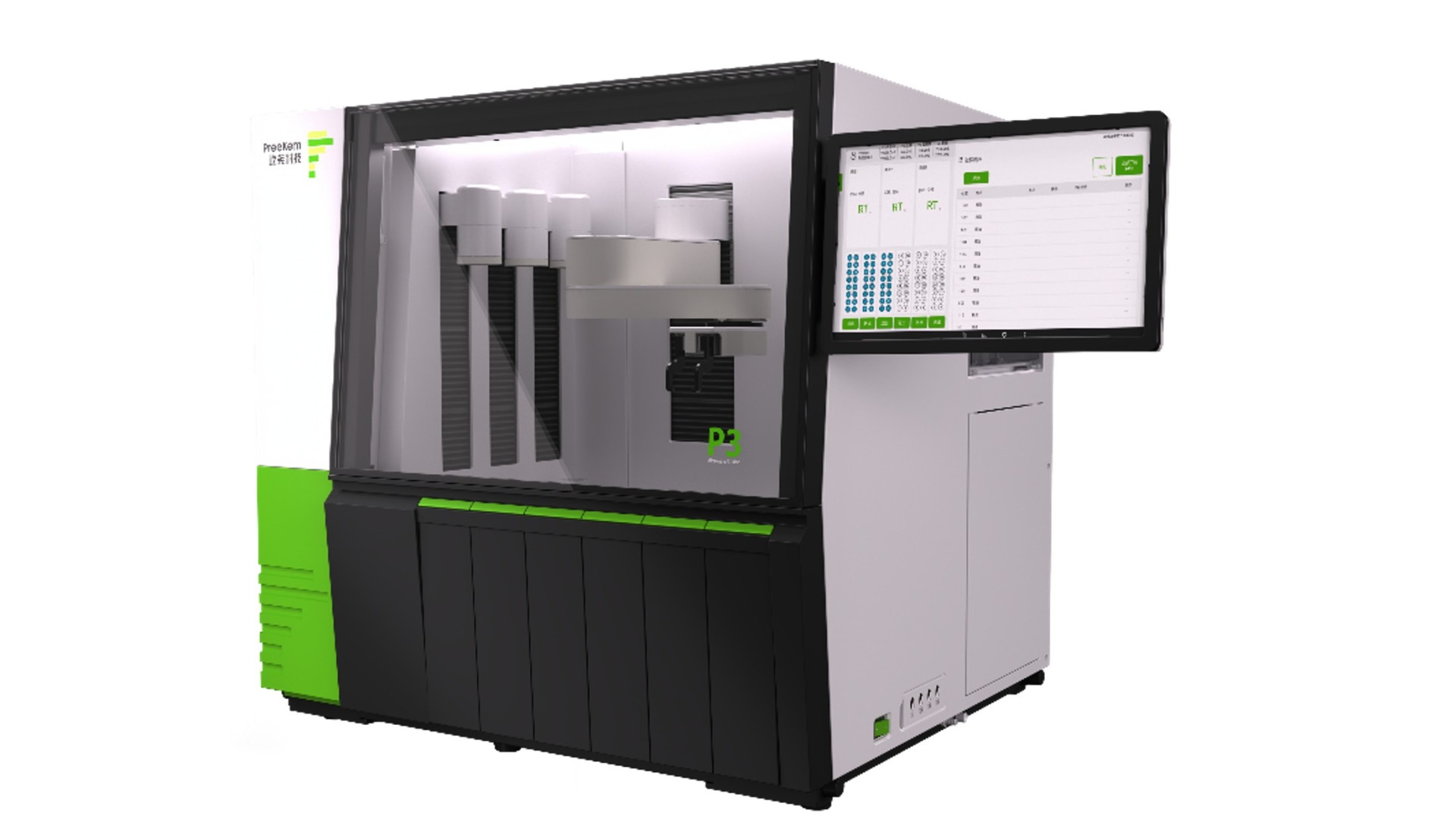

P3 automates microwave digestion from sample to measurement solution
Laboratories are automating more and more steps in their analysis process. The emphasis is often on the analytical instrument itself. However, sample preparation often remains manual.
It is precisely there that a lot of time can be lost. Moreover, differences between operators can affect reproducibility.
With the P3 Automated Microwave Digestion Workstation With PreeKem, a large part of this process can be performed automatically.
Automation of sample preparation
Traditional microwave digestion requires multiple manual steps. These include adding acids, closing digestive vessels, heating, cooling, opening, and diluting.
The P3 brings these steps together in one system.
After the sample has been placed in the digestion vessel, the system can automatically add reagents. Subsequently, a robotic arm processes the digestion vessels. Afterward, the samples are heated, cooled, and further processed.
As a result, the operator needs to perform fewer actions.
Three independent heating chambers
The P3 features three separate microwave heating chambers. These can operate independently of each other.
This offers more flexibility than a traditional batch system. As a result, different samples do not always need to be treated with the same program.
A separate digestion method can be selected for each sample. The order of samples during a series can also be adjusted.
As a result, the P3 is suitable for both routine analyses and method development.
Up to 96 samples in the system
The P3 features six sample racks. A total of up to 96 samples can be placed.
According to PreeKem, the system can perform up to approximately 200 digestions per day, depending on the methods and samples used.
This makes the P3 particularly interesting for laboratories with a high sample throughput. At the same time, individual control per sample remains possible.
Fewer manual steps
Automation is not just about speed. Standardization is also important.
During manual sample preparation, minor differences can arise between operators. For example, when adding reagents or performing different process steps.
The P3 executes these steps according to a fixed program. As a result, the operator's influence can be limited.
Moreover, this helps laboratories to better standardize processes.
Automatic reagent supply and vessel handling
The P3 features automatic liquid dosing. In addition, a multi-axis robotic arm processes the digestion vessels.
This allows various actions to take place automatically in sequence.
First, the necessary reagents are added. Then, the vessels are moved to the correct position. Subsequently, microwave digestion takes place.
After digestion, the samples are cooled. Subsequently, the vessels can be automatically processed further and the sample can be diluted.
This creates a single integrated workflow.
Process monitoring and documentation
The software also plays an important role.
The P3 supports various user levels. In addition, the system can record process data for individual samples.
The system also features camera surveillance of the digestion vessels.
This allows sample preparation to be better monitored and documented.
This is particularly interesting for laboratories where traceability and reproducibility are important.
The individual monster takes center stage.
In traditional microwave digestion, an entire batch is often treated with the same program.
The P3 takes a different approach.
Each sample can be assigned its own digestion program. This allows the system to process different sample types within a single workflow.
For laboratories with variable matrices, this can offer additional flexibility.
In addition, this method can be useful for method development. Various digestion conditions can then be investigated more easily.
From manual preparation to automated workflow
With the P3, microwave digestion shifts from a series of separate steps to an integrated process.
This aligns with a broader development within laboratory automation. Not only is the analysis itself being automated, but also the steps leading up to it.
This allows the laboratory to save time and better standardize processes.
At the same time, the quality of sample preparation remains central.
The P3 can therefore be particularly interesting for laboratories that process many samples, analyze various matrices, or want to further automate their sample preparation.
a1-envirosciences supplies the PreeKem P3 and supports laboratories with the assessment, configuration, and implementation of the system.
More information:
https://a1-envirosciences.com/nl/producten/analyse/p3/