Smart Industry Plaza: three building blocks for the factory of tomorrow
By: Hans Risseeuw
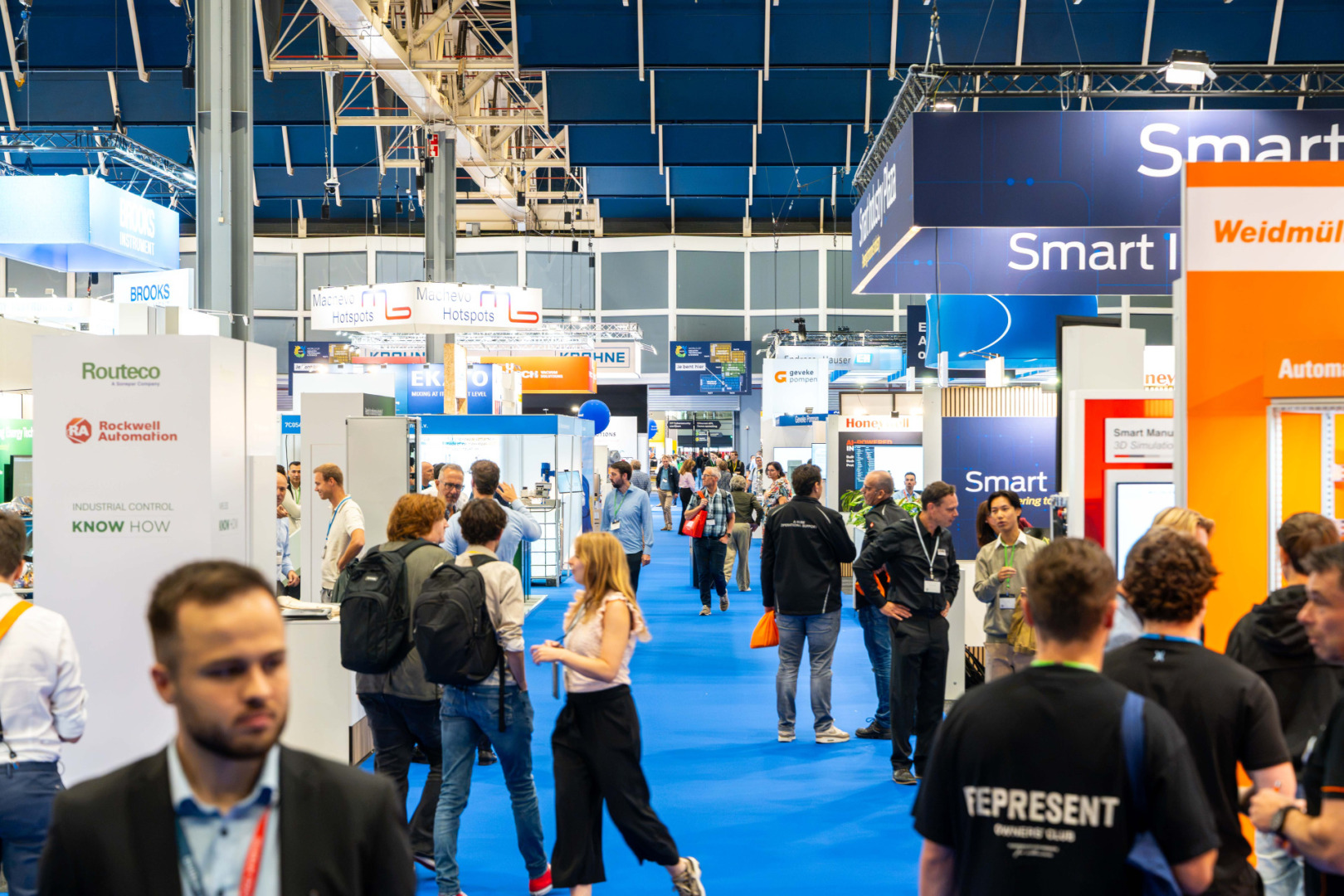
The Smart Industry Plaza program was one of the substantive highlights during WoTS 2026. A clear evolution is emerging behind topics such as Industrial AI, OT cybersecurity, asset performance management, and open automation. The industry is working on a new generation of production environments in which data, software, automation, and human activity are becoming increasingly interconnected.
It is striking that no single technology takes center stage in this. Instead, the program shows how various developments converge. AI provides insights, open systems enable collaboration, and cybersecurity forms the basis for trust. It is precisely this combination that determines what the smart factory of tomorrow will look like.
From data to decision-making
In recent years, industrial organizations have made enormous strides in unlocking data. Sensors, control systems, and software platforms continuously generate information about machines, processes, and performance. Consequently, the challenge shifts from collecting relevant data to utilizing that information.
That theme recurs in sessions such as Industrial AI from Rockwell Automation, Designing software with the power of AI and The Journey to Asset Performance Management from Honeywell. The common thread is clear: organizations are seeking ways to convert data into actionable insights for operators, engineers, and management. AI plays an increasingly important role in this, not as an end in itself, but as a tool to better understand processes, predict maintenance, and make decisions faster.
The discussion thus shifts from the question of what AI can do to the question of how AI actually adds value within existing industrial environments.
Cybersecurity as a prerequisite
A second important line within the program is OT cybersecurity. While cybersecurity was long viewed primarily as a specialized IT subject, there is a growing awareness that digital security is directly linked to business continuity and operational reliability.
This is evident from sessions such as Securing Industrial Operations with OT Cybersecurity, the panel discussion on OT cybersecurity and the presentation A Robust Security Foundation Enables Evolution of Operations Far Beyond Security. The message conveyed by this is that security is no longer a separate project, but a fundamental part of industrial digitalization.
As production sites become more strongly connected to corporate networks, cloud platforms, and external partners, the importance of a robust security architecture also increases. After all, without trust in the digital infrastructure, further automation becomes difficult to realize.
From closed to open systems
A third development concerns the architecture of industrial automation. Traditionally, production environments were built around relatively closed systems in which hardware, software, and controls were closely coupled.
The movement towards open and hybrid environments is central to the Smart Industry Plaza program. This is evident, among other things, from the sessions on hybrid SCADA solutions and the transition from closed to open automation. The panel discussion on smart manufacturing also touches upon this development.
Open systems offer organizations greater flexibility in integrating new technologies, exchanging data, and connecting IT and OT environments. At the same time, they place higher demands on standardization, management, and security. This is precisely why the themes of open automation and cybersecurity regularly come together in the program.
The smart industry emerges in the interconnectedness
What makes the Smart Industry Plaza program interesting is that it does not get bogged down in individual technologies. The various sessions show that digitalization has now become an integral issue.
AI has value when reliable data is available. Open automation enables data exchange between systems and organizations. Cybersecurity ensures that these connections can function securely. Only when these building blocks come together does a production environment emerge that is more flexible, efficient, and future-proof.
The Smart Industry Plaza thus offered a current overview of the issues occupying many industrial companies today. The focus is not on the technology itself, but on the way organizations deploy technology to make production processes smarter, safer, and more manageable. It is precisely in this context that it becomes visible how the industry is shaping the factory of tomorrow, step by step.