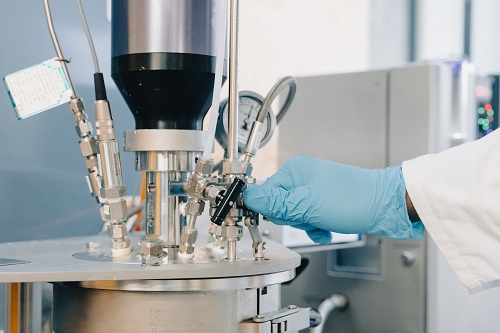

Supercritical CO₂ offers interesting possibilities for new processes. However, high pressure, temperature, and complex phase transitions place high demands on the equipment. How do you make the step from a promising R&D process to a safe and scalable installation?
Above 31.1 °C and 73.8 bar, CO₂ is in the supercritical phase. It combines properties of a gas and a liquid and can therefore be used for, among other things, extraction and purification, chemical synthesis, material processing, CO₂ utilization, and mineral storage.
The benefits are interesting: CO₂ is non-flammable and can be separated relatively easily after the process. Moreover, in closed systems, it can be reused.
The technology behind the process
For process engineers, the challenge lies primarily in controlling the process conditions. Pressure, temperature, and flow must be precisely regulated. At the same time, high pressures and temperatures demand a careful selection of materials, valves, and seals.
Rapid pressure reduction can also cause problems, such as dry ice formation. With corrosive or abrasive media, additional requirements apply to the installation. Therefore, a good design does not start with a standard component, but with the process.
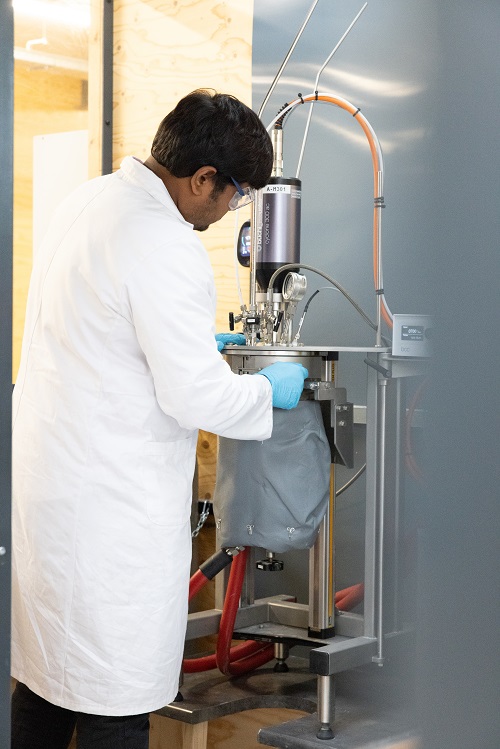
The configuration is in consultation with Suurmond
came into being.
From reactor to dosing system
Suurmond supports R&D and process engineers in translating complex process conditions into a suitable technical solution.
This could consist of, for example:
- Pressure reactors from 0.5 to 500 liters, for pressures up to 500 bar and temperatures from -90 °C to +500 °C;
- High-pressure dosing pumps from HNP-M and GATHER for precise supply of CO₂ and liquid additives;
- Material and seal selection, for example stainless steel, Hastelloy, titanium, tantalum, PTFE or PEEK;
- Custom engineering and integration of reactor, pump, control, and other process components;
- Support with certification, installation, and commissioning.
Depending on the application, systems can be developed for R&D, pilot, and production scales. The transition from batch to continuous processes can also be incorporated.
From idea to scaling up
For new technologies, the equipment is part of the process design. reactor which works excellently on a laboratory scale requires a different approach to pressure control, heat transfer, material selection, and fluid dosing when scaled up.
Suurmond therefore combines reactor technology, fluid handling and custom engineering to make processes technically manageable and scalable.
Curious what is possible for your process?
Visit Suurmond at WoTS at stand 10D051 and discuss your R&D or scaling-up challenge with our engineers.