Getting more out of complex samples: sample prep as the key to deeper proteomics data!

Getting more out of complex samples: sample prep as the key to deeper proteomics data!
Inside proteomics Attention is often focused on the performance of the mass spectrometer, the LC method, or the data analysis. However, reliable and reproducible LC-MS/MS data begins much earlier in the workflow: with the sample. preparation.
Especially with complex biological samples, such as plasma, In cerebrospinal fluid or urine, it can be difficult to clearly visualize low-abundance proteins and peptides. High-abundance components can overshadow relevant signals, leaving part of the biological information difficult to detect. For labs working on biomarker discovery, clinical proteomics, or other applications where deeper insight into the proteome is important, sample preparation can therefore be a decisive step.
From product selection to workflow selection
The question is not always which product is the most advanced, but which workflow suits the sample type, research objectives, and existing LC-MS/MS setup. Many laboratories want to improve their current workflow without immediately switching to a completely new or closed platform. This is precisely where the value of flexible sample preparation solutions lies.
MS Will supports European laboratories with specialized products for sample preparation, separation, and ionization. The focus is not on a single fixed route, but on practical choices that align with existing workflows.
Nanotrap Protein Enrichment Affinity Kits
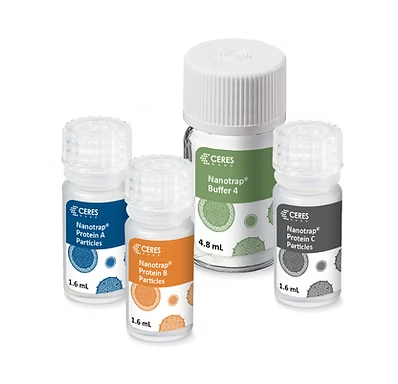
An example within the sample prep portfolio is the Nanotrap® Protein Enrichment Affinity Kit. These kits use magnetic, affinity-capture hydrogel particles to capture and concentrate low-abundance proteins and peptides from complex samples. This allows these components to be better detected in LC-MS/MS analyses.
According to the available product information, the Nanotrap kits have been developed for a simplified and rapid workflow, with a processing time of approximately 45 minutes from raw sample to enriched proteins. The technology is aimed at better quantitative precision, with median CVs below 5%, and deeper access to the proteome, with 3–5 times more protein IDs than other methods.
The kits are available for various sample types, including plasma, cerebrospinal fluid, and urine. Additionally, different Nanotrap particles can be combined to optimize proteome coverage for a specific application.
Practical relevance for proteomics labs
For laboratories working with plasma or serum proteomics, biomarker discovery, or low-abundance proteins, enrichment can be an interesting route to extract more information from existing samples. Moreover, the improvement does not always have to lie in a completely new infrastructure. Sometimes, a targeted adjustment in the sample preparation step can already help to better utilize the existing LC-MS/MS workflow.
This aligns with a broader development within proteomics: labs are seeking greater depth, reproducibility, and flexibility, while simultaneously wanting to maintain control over their own workflow. An independent approach, allowing multiple sample preparation routes to be examined side-by-side, helps researchers make a choice that is both substantively and practically justifiable.
Support with the correct workflow route
MS Wil is happy to help determine which sample preparation route suits a specific application. This may involve protein enrichment, reproducible digestion, high-throughput sample preparation, phosphopeptide enrichment, or other steps within the LC-MS/MS workflow.
Not every lab needs the same solution. The right choice depends on the sample type, the desired depth, the number of samples, the existing instrumentation, and the degree to which a workflow needs to be scalable.
With products such as the Nanotrap Protein Enrichment Affinity Kit, MS Wil offers a practical route for labs that want to get more out of complex samples, without being immediately tied to a single complete platform.
More information about the Nanotrap Protein Enrichment Affinity Kit is available via MS Will.