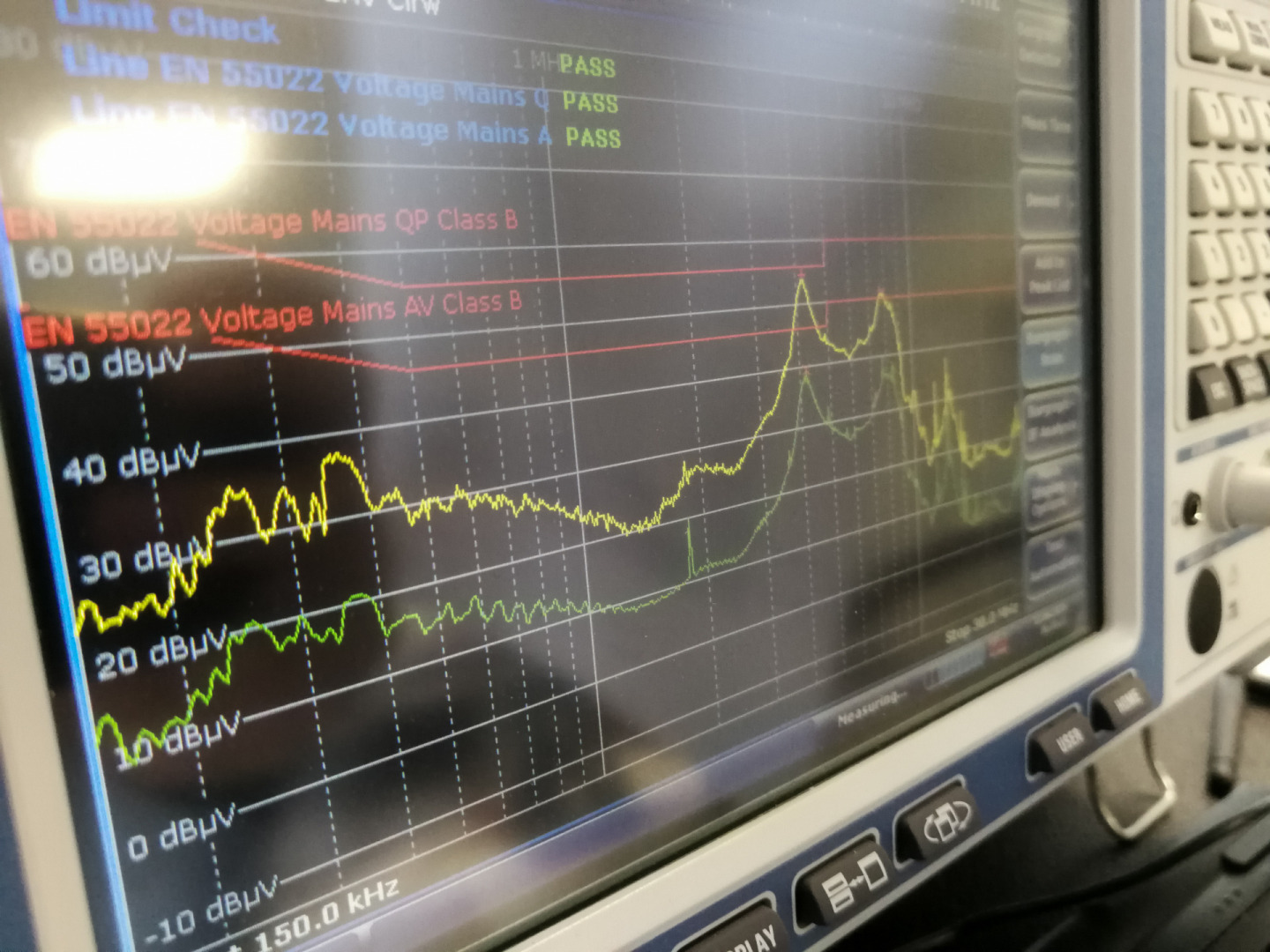
EMC does not start in the test chamber
By: Hans Risseeuw

An electronic design can function perfectly and yet fail to meet electromagnetic compatibility requirements. Waiting to implement EMC until a product is ready for the test chamber can lead to modifications late in the development process. The program for the EMC-ESD event on December 3, 2026, in Belgium shows how EMC issues begin much earlier: with the IC, the printed circuit board, power supply, cabling, and housing.
This starts at the chip level. During the event, Patricia Joris of Melexis Technologies will present a new approach to EMC verification of integrated circuits. Due to platform-based and modular designs, the number of possible IC variants and application modes is increasing. According to the presentation, it is therefore no longer feasible to extensively physically test every combination.[1]
Within the DECID-AI consortium, work is therefore being done on an intelligent diagnostic assistant that predicts where EMC problems may arise based on risks. This should enable designers to identify technical risks earlier, reducing the need for physical testing and redesign cycles.[2]
A concrete example of the choices involved comes from Raf Vleugels of Würth Elektronik Belgium. He examines IC LEDs with single-wire control. Such compact components combine RGB LEDs with an integrated controller, but also present designers with EMC challenges. Signal integrity, power supply, PCB layout, filtering, grounding, and cabling are all addressed in this context.[3]
From printed circuit board to housing
EMC behavior is not limited to the electronics on the printed circuit board. The construction of the final product also plays a role. During the event, Leendert de Voogd of EEMC discusses equipment used in humid, salty, or otherwise corrosive environments.
An enclosure there must combine environmental protection with electromagnetic shielding. This raises material engineering questions. Various metals can cause galvanic corrosion, and shielding performance can change over time. The presentation examines behavior at low, high, and ultra-high frequencies separately.[4]
Measurement is itself a technical issue
No matter how early EMC is incorporated into the design, its behavior must ultimately be measured. Marc Le Roy of Comtest Engineering therefore discusses the various types of EMC test chambers, their key components, and the considerations for having a dedicated test chamber. Both anechoic chambers and reverberation chambers are covered.[5]
The fact that the measurement method itself requires precision is also evident in the case of ESD. Tim Maas of Total ESD Solutions and Pim Dik of Eurostat Benelux focus on measuring conductive floors. The properties of the floor probe used influence the outcome of the test. Therefore, the interpretation of standards, measurement methods, and measuring instruments cannot be viewed in isolation.[6]
Changing standards
Moreover, technical practice is constantly evolving. Frank Niechcial of Accelonix discusses the new 2025 edition of IEC 61000-4-2 for ESD immunity testing. He compares Edition 3 with Edition 2 from 2008 and discusses changes that may affect test setups, calibration procedures, and conformity decisions.[7]
Even for products with wireless technology, the complete system remains the determining factor. A pre-certified radio module is not an automatic route to CE conformity of the end product. According to the presentation on the Radio Equipment Directive, the manufacturer integrating the module remains responsible for the conformity of the entire product.[8]
This creates a unifying theme running through the various topics at the EMC-ESD event: EMC is not just the final check of a design. The properties measured in the test chamber are determined much earlier, from ICs and PCBs to cabling, housings, and material selection. Those who incorporate EMC early in the design can address problems while design choices are still being made.


Sources
[1] Smarter, Faster Silicon: Risk-Based AI-driven Design for Electromagnetic Compatibility – FHI, Federation of Technology Industries
[2] Smarter, Faster Silicon: Risk-Based AI-driven Design for Electromagnetic Compatibility – FHI, Federation of Technology Industries
[3] IC LEDs from an EMC perspective – FHI, Federation of Technology Branches
[4] EMC shielding of electronic equipment in corrosive environments – FHI, Federation of Technology Industries
[5] What is an EMC test chamber and why would I need one? – FHI, Federation of Technology Branches
[6] Conductive floor testing is hard! – FHI, Federation of Technology Branches
[7] IEC 61000-4-2:2025 (Edition 3) | What has changed. – FHI, Federation of Technology Branches
[8] CE Marking for Radio Equipment: Understanding RED Compliance – FHI, Federation of Technology Industries