
CinderBio HTA-Proteases for faster proteomics sample preparation
Proteomics workflows require efficient and reproducible protein digestion. This step has a direct impact on the quality of the LC-MS/MS data.
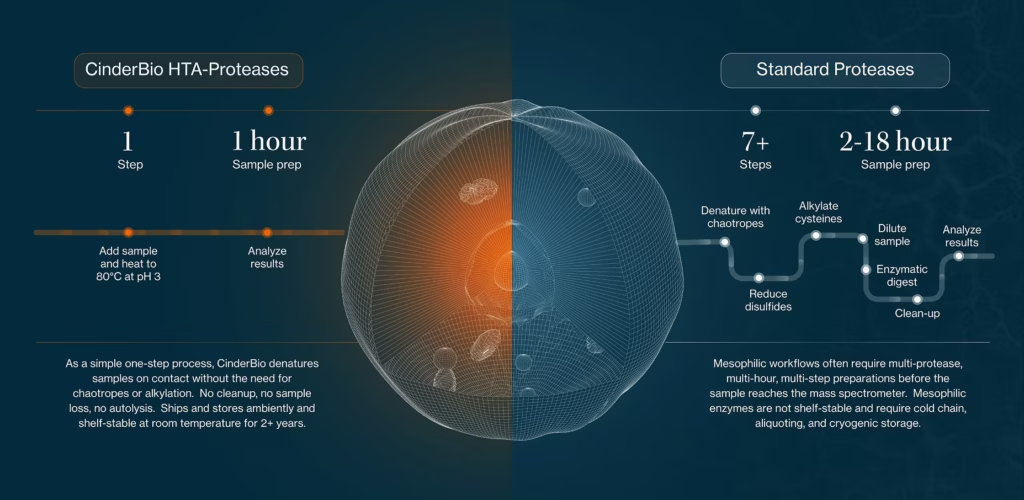
However, digestion can be a bottleneck. Standard workflows are often time-consuming. Additionally, extra steps are usually required, such as reduction and alkylation.
The CinderBio HTA-Proteases have been developed to make protein digestion faster and easier. They work under extreme conditions: high temperature and low pH.
Proteases for challenging samples
HTA stands for HyperThermoacidic Archaeal Proteases. These enzymes are derived from Archaea. These are microorganisms that can live under extreme conditions.
CinderBio's proteases are active at 80 °C and pH 3. As a result, proteins can be efficiently digested without chaotropic substances, reduction, or alkylation.
This could be particularly interesting for labs working with difficult protein groups. Think of membrane proteins and nucleoproteins.
Vesuvius and Krakatoa
CinderBio offers two HTA Proteases: Vesuvius and Krakatoa.
Both enzymes are thermopsin proteases. They have a different specificity than many standard proteases. According to the product information, Vesuvius and Krakatoa have a preference for amino acids E, L, and F.
As a result, they can yield other peptides and protein identifications. This makes them interesting as an addition to existing proteomics workflows.
More information from the same workflow
The use of a different protease can provide additional proteome coverage. This can help extract new information from existing samples.
According to the product information, CinderBio HTA-Proteases can contribute to greater proteome coverage and new discovery space. Short digestion times at high temperatures are also mentioned.
For labs looking to deepen their LC-MS/MS workflow, this can be a practical step. Not by replacing the entire workflow, but by restructuring the digestion step.
Practical to use
The CinderBio HTA-Proteases are supplied ready-to-use. According to the product information, they can be stored at room temperature for more than two years.
The reaction conditions are 80 °C and pH 3. No chaotropic agents or alkylating agents are required.
The product page also states that there is no observable autolysis. This can help limit the background in the analysis.
Part of sample prep
The choice of protease depends on the sample and the purpose of the study. Sometimes a standard protease is sufficient. In other cases, an additional enzyme can provide extra information.
Therefore, digestion is not only a fixed step. It is also an option within the sample prep workflow.
MS Will supports European labs in finding suitable solutions for sample preparation and LC-MS/MS.
Within the broader sample prep portfolio There are multiple routes available. Consider digestion, protein enrichment, plasma enrichment, and peptide enrichment.
More information
For labs that want to accelerate or deepen their proteomics digestion, the CinderBio HTA-Proteases could be an interesting option.
More information is available via the MS Wil product page:
https://www.mswil.com/sample-prep/cinderbio-hta-proteases/